Printed in The American Tri-Five magazine in Volume 4 : Issue 9
With almost 65 years under their belt, some parts of our trusty tri-fives hold up better than others. As I’m sure many have found, it’s few and far between that the factory glass has stood the test of time. Between delamination, wiper scratches, and the occasional kid with a B.B. gun, it’s more common than uncommon to have one of these cars requiring at least one piece of glass being replaced. And understandably, the windshield generally takes the brunt of the “normal” wear. This ’55 150 is no exception, the windshield was just absolutely smoked with pits and wiper scratches. Combine that with the fact I’ll be painting this car before spring, the glass needed to come out. We’re going to show you front and rear glass, since they’re the two most difficult to remove.
As you can see, the windshield was heavily scratched from worn wipers, pitted heavily, and hazy from delaminating. The miles I put on the car last season were tough looking through this, especially in the hours where the sun was low in the sky. Time to go!
Woody’s Hot Rodz was on hand for the removal, and this seal pick is his tool of choice for window installation and removal.
Step one will be getting the wipers out of the way. There are specialized tools just for this, but with a careful hand, the release tab is easily accessed with a pick or small screwdriver. Being as this is a 150, we have nowindow stainless to remove. But if you have a 210 or Bel Air, after the wiper removal, stainless removal would be the next step. Corners off first, and then lowers. The upper trim installs into the window rubber BEFORE installation, and is not able to be removed with the glass in the car.
Garnish's gotta go! Removing the garnish mouldings and rear view mirror will give you full access to the seal on the inside of the car.
With the garnish mouldings out of the way, the pick tool is inserted into the lip on the backside of the window rubber. Work back and forth from the middle to the corner of the windshield you’re focusing on while applying pressure outward.
Push, push, push! Sooner than later, you’ll get one corner free from the body. Keep in mind, the glass is more resilient than you think, so don’t be afraid to apply some real pressure.
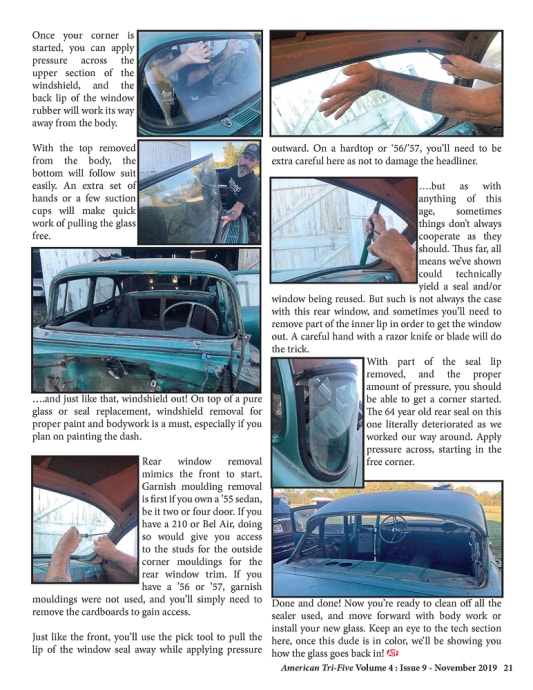
Once your corner is started, you can apply pressure across the upper section of the windshield, and the back lip of the window rubber will work its way away from the body.
With the top removed from the body, the bottom will follow suit easily. An extra set of hands or a few suction cups will make quick work of pulling the glass free.
….and just like that, windshield out! On top of a pure glass or seal replacement, windshield removal for proper paint and bodywork is a must, especially if you plan on painting the dash.
Rear window removal mimics the front to start. Garnish moulding removal is first if you own a ’55 sedan, be it two or four door. If you have a 210 or Bel Air, doing so would give you access to the studs for the outside corner mouldings for the rear window trim. If you have a ’56 or ’57, garnish mouldings were not used, and you’ll simply need to remove the cardboards to gain access.
Just like the front, you’ll use the pick tool to pull the lip of the window seal away while applying pressure outward. On a hardtop or ‘56/’57, you’ll need to be extra careful here as not to damage the headliner.
….but as with anything of this age, sometimes things don’t always cooperate as they should. Thus far, all means we’ve shown could technically yield a seal and/or window being reused. But such is not always the case with this rear window, and sometimes you’ll need to remove part of the inner lip in order to get the window out. A careful hand with a razor knife or blade will do the trick.
With part of the seal lip removed, and the proper amount of pressure, you should be able to get a corner started. The 64 year old rear seal on this one literally deteriorated as we worked our way around. Apply pressure across, starting in the free corner.
Done and done! Now you’re ready to clean off all the sealer used, and move forward with body work or install your new glass. Keep an eye to the tech section here, once this dude is in color, we’ll be showing you how the glass goes back in!
Check out our glass here.