Printed in The American Tri-Five magazine in Volume 6 : Issue 1
There is no question that the craftsmanship and attention to detail found in Tri-Five Chevrolets at most outdoor events has reached epic proportions. The quality builds have become common rivals with what was once seen only in cars at concours and indoor shows, and every year it seems the bar is set higher. But regardless of the level of sophistication this hobby has achieved, or perhaps in spite of it, for many the allure of our beloved Bow Ties isn’t about putting them on static display, rather it’s getting behind the wheel and driving them. It’s exhilarating to look over a classic dashboard and past a shapely hood while watching the miles roll by. Unfortunately the game of one-upmanship often gets in the way of that simple concept.
Certainly we all want our cars to be as nice as we can make them, the problem is often there is a point in the process that results in diminishing returns. In many cases the nicer the car becomes the less it gets driven. The reality of the situation is simple enough-- when you have a bundle of money invested in a Tri-Five it’s not likely you’ll feel comfortable leaving it in the parking lot at work or the grocery store. It’s understandable when you have an average guy’s yearly salary invested in a paint job that the thought of getting a rock chip during a road trip can be ulcer inducing. And if your kid (or grandkid) gets car sick and barfs a strawberry milkshake on your leather covered backseat a catatonic episode is a real possibility. The problem is that it’s hard to win trophies with a car that’s not perfect, and it’s just about impossible to drive one frequently and keep it that way. So a choice has to be made. Which is more important, putting your car on display or driving it? That’s the dilemma Donas Singleton was faced with.
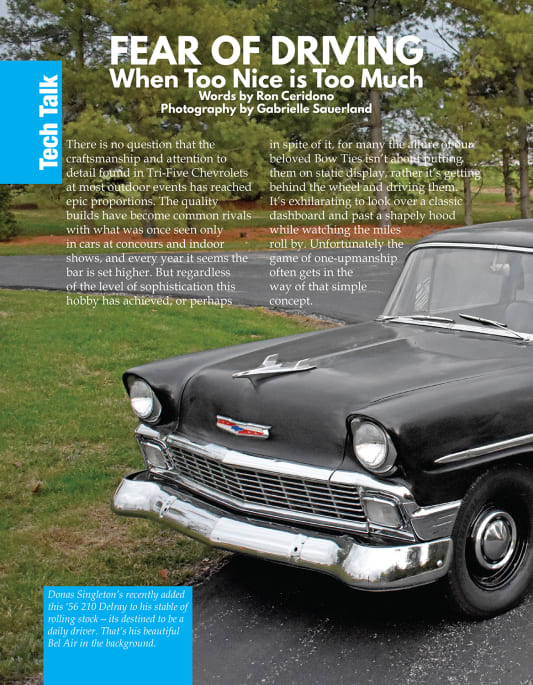
Donas is a bonified gear head with a long history of all things automotive. As a kid he went to the drag races with his father, which would lead to his racing cars, boats and motorcycles. He opened Don’s Auto Trim, one of the premier upholstery shops in the country in ‘72 and a retail parts store in ‘98. When Donas wasn’t stitching award-winning interiors, he concentrated on assembling a stable of outstanding cars, including a ‘56 Chevy that has won numerous awards and been featured in magazines. True to his competition roots, the impeccable Bel Air rides on an Art Morrison chassis and packs a fuel injected 502 big block that puts 502 horsepower to the ground. But while the hardtop is perfect in every respect and is capable of going fast in a straight line and around corners, Donas admits that it can be more than a little nerve-racking to subject such a pristine vehicle to the hazards of yeoman use. So he decided to build a Tri-Five that was a fun to drive but did not have to worry about. As luck would have it, Donas found the raw material to build the car he wanted in a friend’s driveway in the form of a recently purchased, exceptionally clean ‘56 210 Delray. It wasn’t long before a deal was made, the car changed hands again and was on its way to Donas’s garage. Basically, bone stock, rust free and the unmolested two door had received some minor upgrades over the years, but in most respects, the Chevy was just as it came off the assembly line. The stock six-cylinder engine was still under the hood, and the “three on the tree” transmission remained in place.
While the Chevy is in remarkable condition, the kind of regular use it will see means there are several mechanical upgrades it will need. Given Donas’s background more horsepower is in order and these cars can certainly benefit from some brake and suspension upgrades. As the owner of a trim shop, updating the interior will be on the to-do list and convenience items like power steering and a modern climate control system will be added. As for cosmetics, plans are still being formulated, but it’s likely not much will change. Donas thinks the Chevy looks great as it is, and we agree.
When it comes to Tri-Five Chevys if the question is how far to go in the pursuit of perfection, the answer is to the point the car remains more of a source of fun than frustration. Of course it is a personal choice, but sometimes not being too nice is nice enough.
Prior to Donas buying the Chevy, it was treated to a few new trim parts such as the front bumper, grille and hood emblem. The cool part is there are none of the common front fender rust problems like in the headlight eyebrows.
In the rear are a new bumper, trunk emblem and taillights. The factory paint has lost its gloss and is thin in spots, but Donas thinks the patina adds to the cars character. Right: Like most pot metal parts, the original hood bird has blisters due to corrosion. Will it stay or be replaced? We’ll have to wait and When it comes to updating Tri-Five, brakes there are a number of choices from basic GM component to top of the line kits like this caliper, rotor and hub combo from Wilwood.
Power brakes are a wise addition to any Tri-Five. Vacuum boosters are common and for cars with rumpy engines that generally have low manifold vacuum at idle, systems that use pressure from the power steering pump are available.
There are a variety of suspension components available for Tri-Fives ranging from stock rebuild kits to air ride systems with tubular control arms, rear four links and anti-roll bars.
For an affordable interior there are complete kits available in factory patterns and colors. This example is for a ‘56 210 Delray.
To get rid of the warning lights and provide full instrumentation with modern movements, Dakota Digital offers new gauge clusters. This example is for ‘55 and ‘56 cars (gauges for ‘57s are also available).
If you’re driving your Tri-Five regularly, chances are you’ll run into rain so updating the windshield wipers is a wise idea.
For a car that’s driven year round a climate control system with air conditioning, heater and defroster is a worthwhile investment.