Printed in The American Tri-Five magazine in Volume 5 : Issue 2
Making a selection for the right suspension components can be one of the toughest choices to make when putting together a tri-five. It can literally make or break an entire build, and can solely determine how enjoyable a car is when it’s finished. But, when the properly combined parts are chosen, it can make for a 100% enjoyable fresh build, or turn your soft stocker into a road-holding cruiser.
The’55 Del Ray you see on these pages is starting out as a 100% stock, 235/Powerglide unit. After years of being enjoyed as more of a novelty “around-town” type of car, he’s looking to transform it into a more user-friendly driver that can be taken anywhere. A simple, to the point cruiser with a stock-style body and interior, but modern underneath.
The biggest complaint currently lies within the drivability of the car in question. Being a factory power-steering car as well (which you’ll see removed and updated with modern power steering in articles to come), the factory suspension geometry, paired with bias-ply tires leaves a lot to be desired when it come . The choice was made to use Woody’s Hot Rodz new Ultimate Suspension Package for an easy, bolt-on upgrade from mushy stock suspension without much in the way of external modification. The package at hand utilizes CPP Budget series tubular control arms up front paired Viking Performance double adjustable coilovers, Woody’s Hot Rodz 7/8” front sway bar, Woody’s Hot Rodz 2” drop 5-leaf poly-button springs, and Viking Performance double adjustable rear shocks to round the package out.
As with most projects with this particular car, you’ll see it up on a 2-post lift. Where it makes life easy, by no means is it a necessity to accomplish all the steps you’ll see here.
Wheels up, but not in the gasser sense! First things first, wheel removal is required at all four corners. The stock wheels and tires shown will not be reused, as new wheels and radials are on the docket. Stay tuned there!
Where it’s not a necessity, especially if not being reused, we went ahead and removed the brake assembly, mainly to show the next photo. This entire setup is compatible with factory spindles and/or drum brakes, if you’d be so inclined to leave them. This is a great point in time to upgrade to drop spindles or disc brakes, as will be done with the Del Ray.
“Bearing” down! These ball bearings are one of the biggest weak points in any tri-five that sees extended amounts of use. Modern taper bearings are the key for reliability on a car that’ll see highway speeds, including this one.
You’ll need to remove the tie rods from the steering arms. Typically a whack or two to the steering arm with a hammer will set them free once the nut is removed, but more stubborn pieces may require use of a pickle fork. These again, will be replaced at a later date.
The brake hose will need to be unhooked. Since this car will be getting discs, this one will be hitting the trash!
At this point, we’ll go ahead the remove the shock. I tend to always do the top first, as a little tension on the setup may or may not let you get the top nut off without holding the rod.
….bottom comes next. With the lower shock bolts removed, it’ll simply slip through the lower control arm. Again, these will not be reused.
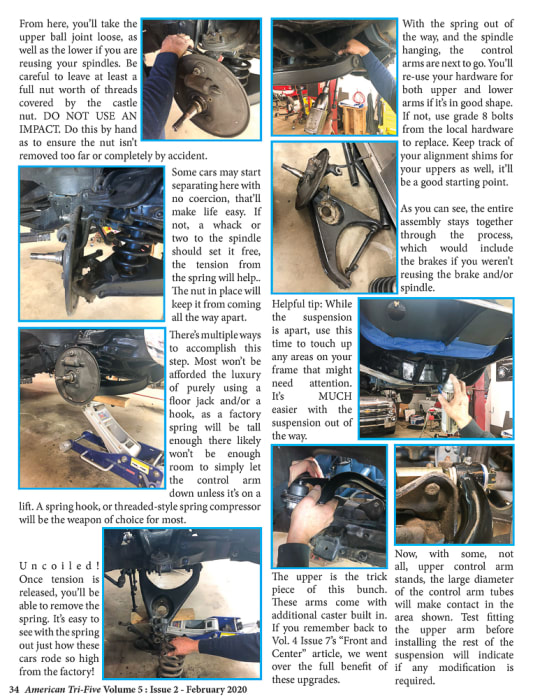
From here, you’ll take the upper ball joint loose, as well as the lower if you are reusing your spindles. Be careful to leave at least a full nut worth of threads covered by the castle nut. DO NOT USE AN IMPACT. Do this by hand as to ensure the nut isn’t removed too far or completely by accident.
Some cars may start separating here with no coercion, that’ll make life easy. If not, a whack or two to the spindle should set it free, the tension from the spring will help.. The nut in place will keep it from coming all the way apart.
There’s multiple ways to accomplish this step. Most won’t be afforded the luxury of purely using a floor jack and/or a hook, as a factory spring will be tall enough there likely won’t be enough room to simply let the control arm down unless it’s on a lift. A spring hook, or threaded-style spring compressor will be the weapon of choice for most.
Uncoiled! Once tension is released, you’ll be able to remove the spring. It’s easy to see with the spring out just how these cars rode so high from the factory!
With the spring out of the way, and the spindle hanging, the control arms are next to go. You’ll re-use your hardware for both upper and lower arms if it’s in good shape. If not, use grade 8 bolts from the local hardware to replace. Keep track of your alignment shims for your uppers as well, it’ll be a good starting point.
As you can see, the entire assembly stays together through the process, which would include the brakes if you weren’t reusing the brake and/or spindle.
Helpful tip: While the suspension is apart, use this time to touch up any areas on your frame that might need attention. It’s MUCH easier with the suspension out of the way.
The upper is the trick piece of this bunch. These arms come with additional caster built in. If you remember back to Vol. 4 Issue 7’s “Front and Center” article, we went over the full benefit of these upgrades.
Now, with some, not all, upper control arm stands, the large diameter of the control arm tubes will make contact in the area shown. Test fitting the upper arm before installing the rest of the suspension will indicate if any modification is required.
Clearance can be accomplished with some heat and a hammer, or simply trimming a small amount away with a grinder. Again, how much will vary per car. We only needed a very small amount with this one.
Reinstallation shows we are good to go with ample clearance.
The Viking coilovers use provided 3/8” mounting hardware, where the control arms are made to accept factory 5/16” shock bolts. Rather than step up washers and use factory-sized bolts, we went ahead and drilled the control arms out for the bigger 3/8” hardware to thru-bolt the coilovers on.
Apply a generous helping of anti-seize to the shock. This will help fight galling and corrosion with the spring perch and lock collars, and insure that ride height adjustments will be made with ease. Go ahead and install the spring adjuster and lock collar shoulder side up.
The Viking coilovers also come with a roller bearing for ease of height adjustment. A coating of grease here will keep things moving as they should for years to come.
Yup, you guessed it, more grease! This time on the t-bar for the lower shock mount. This will keep the shock moving freely and quietly through its range of motion while driving.
With everything greased, and your lock/height rings installed, go ahead and bolt the coilover to the control arm. Make sure to keep everything centered between mounting points to prevent binding.
Helpful tip: put a mark on the spring aligned with the end of the coil, this way you know where the spring is to be seated in the pocket.
With the coilover all together, you’ll swing the lower control arm into place. Extend the shock while rotating the lower control arm upward, and guide the shock stud through factory hole in the frame. Install the nut finger tight to hold everything in place.
With the coilover in place, you can begin re-installing the spindle, bottom side first, then swing the upper control arm down to it.
With the spindle in place, go ahead and torque the ball joints and install cotter pins, as well as torque the top shock bolt. And there you have it, a fully assembled new front suspension! If you were reusing your steering, now would be the time to reinstall those parts. We’ll be covering that in coming months.
You’ll want to spin some preload into the spring at this point, while it’s easily accessible. My rule of thumb is 1/3 the way up the shock body as a starting point.
Now we move on to the back. The Del Ray received newer poly button springs at some point, but at stock ride height. This one will certainly reap the benefits and improved handling of a lower center of gravity without sacrificing ride quality, not to mention a killer stance. Support the rear end, and unbolt the factory shocks and lower shock plates.
With the shock plates out of the way, remove the u-bolts. If yours are in rough shape, have the guys at Woody’s add WHR-80016, quantity of 4 to your kit.
With the u-bolts, shocks, and plates out of the way, go ahead and remove the front eyelet bolt through the access hole in the frame. You may need to give it a whack or two with a drift pin, as they may have been in there for 60+ years. A set of extra hands really comes in handy.
Once the spring is loose from the front pocket, swing it down and unbolt the rear shackle retainer. Once the retainer is off, you should be able to wiggle the spring free from the shackle itself. If you’re replacing the shackle bushings like we are, swing the shackle above the frame, and slide it off. This may take some help from a pry bar, depending how long they’ve been in place.
With the shackle out clean up the inside of the perch on the frame. A generous helping of grease here will ease installation and yield quiet operation. Remember, the shackle is supposed to move!
When installing new bushings, be sure to give them a thin coating of grease just the same. The Sta-Lube silicone brake and caliper grease is my go to here.
The Del Ray was still sporting the factory shackles, which weren’t horrible, but not great either. At any rate, we opted to install 062 shackles as well, which come complete with new bushings. Installation is reverse of removal, nothing special there, but be careful not to overtighten the shackle bolts and bind the assembly. Again, these pieces are intended to move freely.
With the new shackle in place, and the rear leaf slid on, go ahead and swing it in place, and bolt it through the frame. Your new leafs come pre-installed with a new front bushing, so no additional work required there!
Now, you can re-install the spring plates and your u-bolts Make sure the shock mounting stud is free of rust and clean, if your leaf spring plates have any excess corrosion on the stud, use CPP-5557LSP to replace. A thin coating of grease on the stud will aid installation in the shocks.
With the spring plates done, you can install the Viking double adjustable rear shocks. These shocks are aluminum bodied units with individual adjustment for bound/rebound, giving you ultimate control over handling, ride quality, even traction on launch for the horsepower enthusiasts. Slide the shock onto the spring plate first, as this may take some wiggling, and you don’t want to fight the upper bushings. Install the nut, and install the lower half of the bushing onto the shock rod, and extend the shock rod through the trunk or shock bar.
With installation complete below, you’ll move up into the trunk, or shock bar if you have one in place. Install the top half of the bushing, and tighten the shock mounting nut down. And now your rear suspension is complete!
The final piece of the puzzle lies in the 7/8” front sway bar kit. This beefy kit takes out excess body roll, again without affecting ride quality. Note the kit includes 90* angle brackets for control arm mounts. These mounts will not be used here, as our control arms already have sway bar mounting points.
From here you’ll pre-assemble the upper part of the sway bar end links. it’s a must for the next step.
Carefully lift the sway bar into place. You can use a floor jack to support to middle section of the sway bar, as you’ll need to make some marks pertaining to mounting coming soon. Go ahead and bolt the sway bar end links all the way on as shown, leaving them only hand tight.
With the bushings and retainer slipped into place, jack the sway bar up until it makes contact with the frame. Go ahead and mark only the front mounting holes. Then, drop the sway bar out of the way, and use the u-bolts to measure out and mark the rear holes.
With the sway bar still dropped, go ahead and drill these holes using a 3/8” or slightly larger bit.
With your holes drilled, slip the u-bolts up into the frame and down through your holes, and jack the sway bar back up to meet them. Torque them down using the provided lock nuts, and tighten down your endlinks.
Sway bar complete, and complete suspension upgraded!
Even though there’s more work to be done yet, we just couldn’t resist bolting some rollers back on and giving a glimpse of things to come. Look for more articles coming with this one, including modern steering upgrades, engine swap how-to, how to pick the correct set of wheels, and more!
Check out our Ultimate Leaf Spring Suspension here.
Click here for chassis kits & components.