Printed in The American Tri-Five magazine in Volume 6 : Issue 5
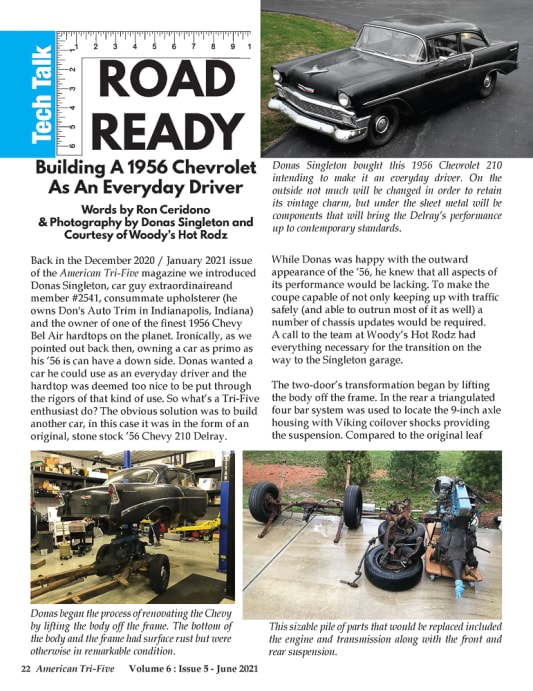
Back in the December 2020 / January 2021 issue of the American Tri-Five magazine we introduced Donas Singleton, car guy extraordinaire and member #2541, consummate upholsterer (he owns Don's Auto Trim in Indianapolis, Indiana) and the owner of one of the finest 1956 Chevy Bel Air hardtops on the planet. Ironically, as we pointed out back then, owning a car as primo as his ’56 is can have a down side. Donas wanted a car he could use as an everyday driver and the hardtop was deemed too nice to be put through the rigors of that kind of use. So what’s a Tri-Five enthusiast do? The obvious solution was to build another car, in this case it was in the form of an original, stone stock ’56 Chevy 210 Delray.
While Donas was happy with the outward appearance of the ’56, he knew that all aspects of its performance would be lacking. To make the coupe capable of not only keeping up with traffic safely (and able to outrun most of it as well) a number of chassis updates would be required. A call to the team at Woody’s Hot Rodz had everything necessary for the transition on the way to the Singleton garage.
The two-door’s transformation began by lifting the body off the frame. In the rear a triangulated four bar system was used to locate the 9-inch axle housing with Viking coilover shocks providing the suspension. Compared to the original leaf springs coilovers offer a number of advantages. The double adjustable Viking shocks allow the compression and damping traits to be adjusted for the best combination ride and handling characteristics. The easily changed coils allow the spring rate to be optimized and the threaded adjustable spring preload collars allow the ride height to be altered.
Up front a variety of improvements were also made. Woody’s provided a Ridetech steering kit that included a Delphi 600 power steering box with a 12.7:1 ratio. Compared to the stock steering with its 20:1 ratio, the new box is quicker (fewer turns lock to lock) which will result in vastly improved road feel and feedback. The steering box bolts in place using the factory mounting holes.
To improve the front suspension geometry and lower the Chevy’s ride height, Donas opted to install Woody’s upper and lower tubular control arms and dropped spindles. Made from DOM (drawn over mandrel) tubing, the new control arms are lighter and stronger that the factory components, and they increase caster for better straight line stability. The control arms came with the ball joints installed along with billet cross-shafts. As in the rear Viking double adjustable coilovers were installed. These are direct replacements for the stock springs and shocks as they utilize a T-bolt mount on the lower like the factory shocks and the upper portions of the springs fit into to the original spring pockets in the crossmember.
To ensure the Chevy stops as well as it goes, Wilwood brakes are used on both ends. The forged billet Dynalite calipers feature four pistons each and will clamp down on 12.19 inch rotors front and rear. The master cylinder/power booster system will be a hydroboost unit that uses pressure from the power steering pump rather than engine vacuum to help apply the brakes. For parking brake, and as a theft deterrent, a push button electronic emergency brake system will be installed.
With the chassis modifications complete Donas is confident the 210 will have the ride and handling characteristics he’s after. Donas still has some interesting plans and a few tricks up his sleeve as the Chevy goes back together. We’ll show what they are as more progress is made, and you can bet they will all make this daily driver road ready.
Photo captions
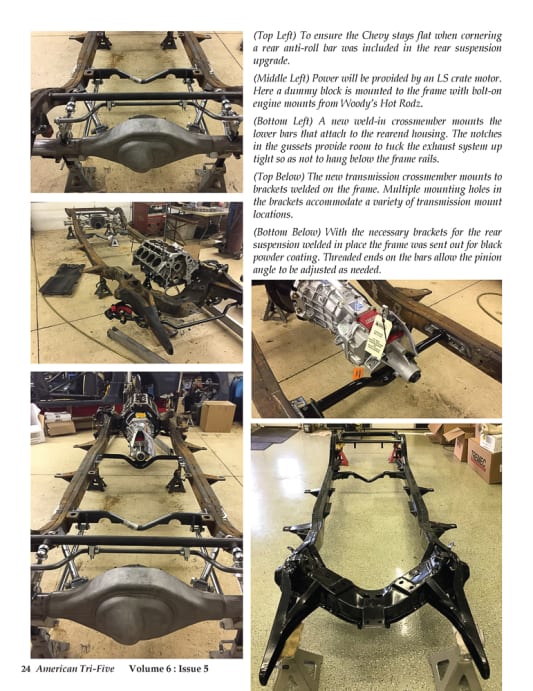
To ensure the Chevy stays flat when cornering a rear anti-roll bar was included in the rear suspension upgrade.
Power will be provided by an LS crate motor. Here a dummy block is mounted to the frame with bolt-on engine mounts from Woody’s Hot Rodz.
A new weld-in crossmember mounts the lower bars that attach to the rearend housing. The notches in the gussets provide room to tuck the exhaust system up tight so as not to hang below the frame rails.
The new transmission crossmember mounts to brackets welded on the frame. Multiple mounting holes in the brackets accommodate a variety of transmission mount locations.
With the necessary brackets for the rear suspension welded in place the frame was sent out for black powder coating. Threaded ends on the bars allow the pinion angle to be adjusted as needed.
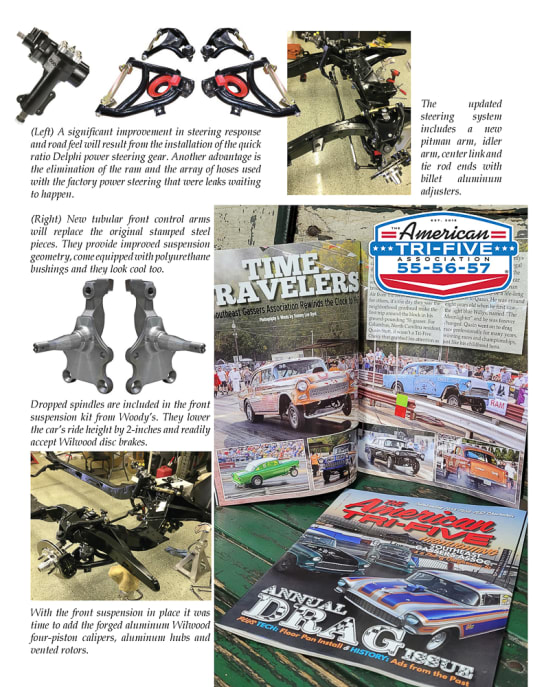
A significant improvement in steering response and road feel will result from the installation of the quick ratio Delphi power steering gear. Another advantage is the elimination of the ram and the array of hoses used with the factory power steering that were leaks waiting to happen.
New tubular front control arms will replace the original stamped steel pieces. They provide improved suspension geometry, come equipped with polyurethane bushings and they look cool too.
Dropped spindles are included in the front suspension kit from Woody’s. They lower the car’s ride height by 2-inches and readily accept Wilwood disc brakes.
With the front suspension in place it was time to add the forged aluminum Wilwood four-piston calipers, aluminum hubs and vented rotors.
The updated steering system includes a new pitman arm, idler arm, center link and tie rod ends with billet aluminum adjusters.
Like those in the rear the front Viking coilovers are double adjustable. The billet aluminum shocks come with 450 lb. springs for small-block and LS applications; 550 lb. springs for big-blocks.
As in the rear, and anti-roll bar was added up front to keep the tires planted in the corners.
With the chassis modifications under control the body was mounted to a rotisserie so the bottom could be steam cleaned.
Once the bottom of the body shell was cleaned it was coated with truck bed liner to protect it from the elements.
To clean up the engine compartment all the unnecessary holes were filled then the firewall was smoothed.
Click here for chassis components.