Printed in The American Tri-Five magazine in Volume 1 : Issue 5
It’s no secret that the right wheel and tire and combination can absolutely make or break a car. It never fails, any car show I go to, there will be some drop-dead stunning car there (and it may not even be a tri-five) that has every aspect covered but has a wheel combination that either misses the mark in style, or even worse, fitment.
Now, style is a completely subjective point, yes. There’s plenty of folks who love Cragars and Rally wheels, just as there’s guys who wouldn’t think of putting anything but a 17+” modern wheel on their ride. But the big point to make that anyone can agree on is making sure that whatever goes onto your car actually fits. And I don’t mean just “bolts on,” I mean making the wheel fit the car as well as it can. Choosing the proper backspacing and tire size is every bit as important as picking out what style of wheel you’re purchasing.
Picking the wrong wheel can, worst of all, be VERY costly; most wheel companies have a “you mount it, you own it” policy; you’re on the hook for them the second you put a tire on it, whether they fit your car or not. So, not only is this important for the sake of fitment, but for your pocketbook just the same. No one wants to be left taking a hit selling a “used” set of wheels, even though they may not have a mile on them. This becomes especially important if you’re looking to push the envelope at all, maybe trying to run that steamroller of a tire you’ve always wanted.
So, we’re going to run this article in a two-part series. We’ll focus on the rear of the car in this article, and the fronts the next time around.
To start off, we’ll need to clear up some terminology you’ll see in both parts of the article, and how it is relative to your wheel choice.
Width: The cross-section of either the tire or the wheel. Both get taken into account when choosing a new combination. Are you looking for something reasonable, or looking to fit as big as you can under your car?
Diameter: The outside dimension of either the wheel or the tire. Also referred to as “height.” 14”, 15”, and beyond, your tastes will determine the flavor here.
Backspacing: The distance from the mounting surface of the wheel (where it bolts to the axle/brake) to the outside of the tire mounting surface on the BACK side of the wheel. This is not to be confused with “offset,” which more and more manufacturers use as their specification these days (see the provided illustration on conversion). I’m particularly old-school about it, so I always run with backspacing when it comes to spec’ing a set.
Continuing the technicalities, lets take a look at what all the numbers on a modern tire really mean. This is one place there’s always a fair amount of confusion/misconception. We’re going to look at modern metric tire sizes, since this is how 99% of us will be buying rubber, and later on, will look at configuring these numbers into standard measurements.
We’ll use a 255/60r15 as my example (my go-to 15” tire).
255: This indicates the cross section of the tire is 255 millimeters wide. I know, some people just groaned at the metric system being used, but I think we can all agree that a finite level of measurement, as opposed to the old standard of 6.70-15 or N50-15 will make a job like this where precision is key a world easier to figure out.
60: This is called “aspect ratio.” The common misconception here, is that aspect ratio somehow plays into the width, when in all reality, it’s the other way around. The aspect ratio refers to the sidewall height, as a percentage of the section width. In this case, the “60” is 60% percent of 255mm, yielding an overall sidewall height of 153mm, or roughly 6”. This would be all the way around the tire, so it’d be 306mm/12” total. Add that to your wheel diameter of 15”, and you wind up at 27” overall height. If you took this same tire and made it a 50-series tire, it’d effectively become 127.5mm/5”, yielding a combination of 25” overall. Keeping that in mind, the sidewall percentage doesn’t change for the rim size, so every inch of rim diameter you add directly equates to an inch of overall tire height. AKA, a 255/60r18 would be 3” taller overall than a 255/60r15.
R: This indicates the tire is of radial construction. In modern sizes and high-performance tires, you may see a “ZR” here, meaning the tire is rated for 150+ MPH continuous use.
15: Easy enough, this means the tire is designed for a 15” wheel.
So, let’s delve deeper into how to size up those rollers for the back of your ride!
Know your rearend width!
This is non-negotiable. You MUST know your rearend width in order properly size your wheels. Factory width is right at 60”…..and I STILL recommend measuring your factory rear if you’re planning on maxing out your specs. Even if an aftermarket manufacturer built your rearend to factory specifications, you need to check, ESPECIALLY if you’re looking to max out
Know your brakes!
Put the binders on before heading forward….what brakes are on your setup? Factory drums? Aftermarket discs? If so, what brand? What diameter? Many manufacturers like Wilwood will have brake kit measurements on their site to further assist with the wheel sizing. Certain wheels, Rocket Racing’s Injector have a beveled lip that yield them with a smaller barrel, making them incompatible with many brake kits.
Know your combination.
It may sound silly….but in a day and age of buying a car that may have had modifications made throughout the years, It’s best to make a close inspection and know what you’re dealing with. Has your rearend been replaced? If so, WHAT was it replaced with? Was that modified in any way? Are your leaf springs moved? Has a minitub been done? All things to verify before embarking on a journey.
Measure twice, order once
You can do everything you need to know by simply getting your favorite measuring device from the toolbox and going to town. By holding your tape measure across the wheel opening, and referencing the wheel mounting surface, you can effectively figure up every measurement you need to take, including backspacing and total width. But, we’ll move along to my preferred method…..
Known Winners
On the back, there are some pretty given standards. If your rearend is done to a factory width (or very close to), your leaf springs are in the factory position, and your wheelwells are unmodified….an 8” wheel, 4.25-4.75” backspace, and a 255mm width tire is about it *comfortably. * Now, whether that’s a 255/45zr20, or a 255/60r15, width wise, anything more will in fact be pushing the envelope. Height-wise, 28” is a safe maximum. Anything more, along with increased width, and you very well may see rubbing issues without trimming the inner lip at the doglegs, or clearancing the inner front wheeltub (that’s where it’ll always get tightest height-wise).
Trial Fitment
Now, not EVERYONE may have access to means like this, but most people have a buddy who has a spare, loose wheel and tire of some sort laying around. This can serve as the perfect jump-off point for sizing up a new set of wheels, even if it’s not the size you intend to run. Simply having a visual representation with a fixed measurement can be an invaluable tool rather than sizing up from nothing.
Our test wheel and tire consists of a Mickey Thompson ET Street R radial, 255/60r15 (P/N 3553), mounted on a 15x8 Wheel Vintiques smoothie (P/N 12-581204). We’re also using a '55 for this example, as the wheelwell is typically the tightest. 1956 and 1957 owners may have more room. I know this tire fits a stock configuration, as it's from another '55 in the stable. This build, however, is outside the norm, so it’ll serve as a perfect start for “how much room do we have for the given application?”
First things first, we need to establish backspace. Take a straightedge, and go across the backside of the wheel. Note this is NOT on the outside edge, but instead to the bead where the tire would seat to. The tape tells the story, 4.25” backspace. Wheel Vintiques calls this wheel out as 4”, so this is why it is important to verify. Remember, specs are specs, but the tape measure doesn’t lie!
Next, we need to find out width on the rearend. As mentioned, this rearend is completely custom, so figuring out an *exact* measurement is needed. Put a straight edge on the mounting flange area of each brake hat (this is otherwise known as “face to face”). We come in right at 55.75”.
Let's verify the width of the tire you’re using. I’ll tell you now…. you WILL see some variance in tires between manufacturer, as well as spec vs. reality. Use a straight edge on either side of the tire bulge to get your section width. M/T calls this tire 10.3”, however, on our 8” wheel, we measure out right at 11”. Again, very important to know what you’re actually working with opposed to just taking and specification at face value.
Mickey Thompson calls this tire 27.5 inches tall. Mathematically, a 255/60r15 comes up to 27” tall, verified by tiresize.com/calculator, a helpful tool when converting metric tire sizes over to inches for overall dimensions, and this one fits more true to the given measurement than the spec. Note that much taller than this, and things will start getting very close to the doglegstep. This is where my 28” rule-of-thumb comes into play. You can push the envelope, but some modification/trimming may be required.
Now, this is where knowing the combo comes into play. We know this wheel/tire setup works with a leaf spring car and a stock rear. This application is shortened rear, 4-linked, and using the Golden Star Minitub (GDS-WH13-551TP), so the tire is significantly closer to the wheelwell than a factory setup. In a factory setting, this wheelwell would be roughly 2.125” over towards the quarter, yielding enough room to clear the leaf spring that would/should be there.
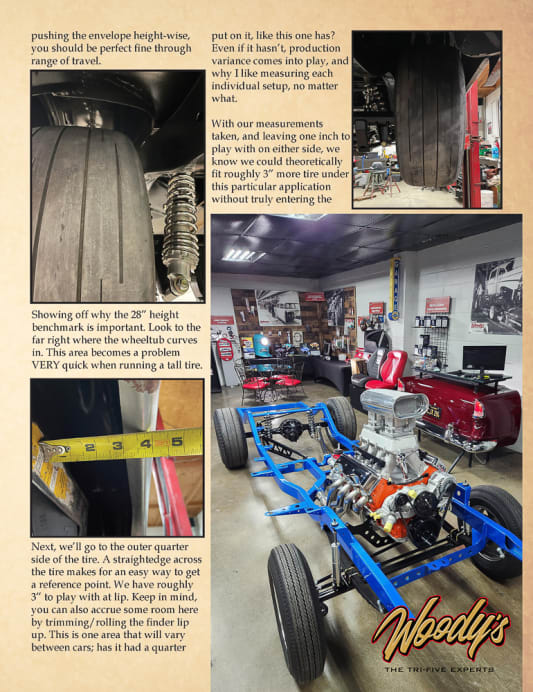
We have roughly 2” to the inner wheelwell in current form. Keep in mind, these measurements are taken hanging, but as long as you’re not pushing the envelope height-wise, you should be perfect fine through range of travel.
Showing off why the 28” height benchmark is important. Look to the far right where the wheeltub curves in. This area becomes a problem VERY quick when running a tall tire.
Next, we’ll go to the outer quarter side of the tire. A straightedge across the tire makes for an easy way to get a reference point. We have roughly 3” to play with at lip. Keep in mind, you can also accrue some room here by trimming/rolling the finder lip up. This is one area that will vary between cars; has it had a quarter put on it, like this one has? Even if it hasn’t, production variance comes into play, and why I like measuring each individual setup, no matter what.
With our measurements taken, and leaving one inch to play with on either side, we know we could theoretically fit roughly 3” more tire under this particular application without truly entering the danger zone, or requiring further modification. This particular car is slated to get a 15x10” wheel and Hoosier Quick Time Pro tire that is 28” diameter with a section width of 13”, only two inches wider than our current tire. Our math shows this tire will work perfectly by simply keeping our same backspace (or close to it), and adding the 2” to the front. Even if our tire wound up slightly wider than advertised, or the wheel was 1/8” off on the backspace in either direction, or even both for that matter, we’re still going to make it no problem.
Sometimes, some amount of “fudge” is necessary. A SMALL (read: ½” or less) spacer made specifically for your bolt pattern is acceptable to use without adverse effect for getting things absolutely perfect if the scenario calls for it, or making an off the shelf wheel work with your application. If you do choose to run spacers, it is imperative to check that you have enough lug nut to wheel stud engagement to do so safely.
Stay tuned for next month’s installment on front wheels!