Printed in The American Tri-Five magazine in Volume 7 : Issue 6
In this article, I will be giving you some tips and tricks, that I have learned over the past 15 years here at Woody's, from the start of a body in bare steel with the metal repair done (or a new Woody's body in our case), to buffing that clear-to-a-mirror shine. Just remember, this is not an all-inclusive how-to-paint tutorial, but more what to look out for when you are working on your own car, or what to watch when having a shop do your restoration. If you have a restoration shop building your dream, this can help bring up some questions to make sure your car will look as good from mile 1 to mile 100,000.
We will start off running; as this is about bodywork and not metal work, at this point all your metal work should be done. Meaning, all your welds done, all sheet metal has been hung, and gaps made to your liking.
So, starting with a car that’s fresh back from the blaster, you’ve cut, welded, and welded some more whether fixing a wrecked panel or repairing rust. Now, it’s time to grind those welds.
One thing I see more often than I would like is a weld grinded on two pieces of flat metal using only the first 1/8” of the grinding wheel or disk. What this immediately tells me is that the weld may not be ground flat, and still could be higher than the metal around it, making high spots for you to fight when you start sanding your body filler. Try your best to hold whatever grinding apparatus you’re using flat as can be across the weld.
Another point to look out for at this stage is the original lead seams. Many times, these seams can physically come loose from the metal they were once attached to. Remember, these cars are 60+ years old now, and that body flexing all those years can simply separate the lead from the steel and let water in under it, but not out very easily. So, when dealing with lead seams, I like to get rid of the old lead totally and completely by torching it out and put a good fiberglass reinforced filler in its place.
The fillers available nowadays have come a long way over the years, and are now able to last much longer, usually the life of a paint job all together without issue if applied correctly. This starts with reading the instruction on the type of filler you are using. Some fillers require 80 grit DA marks, some only 180 grit DA sanding scratches to bite into the bare metal or other filler around the application area. The fillers I use here at Woody’s take both 80 grit and 180 grit sand scratches to adhere how they are intended to.
So, metal work is done, body work is done, it’s prep time for your first prime.
This is one part where you will have to do a little reading. At this point, you’re ready to spray either an etch primer, an epoxy primer, or a direct-to-metal primer, and you’ll need some info on the exact product you’re going to spray.
Pull up your product data sheet on your particular material, and find out what prep is needed for different surfaces: bare metal, filler, or existing finish. Remember, everything is on top of this first coat of material, all the way to the clear. I like to use an epoxy primer for my first coat for two reasons.
One, the epoxy I use can be used as a sealer as well. This means my base coat can actually adhere directly to it, if prepped correctly and the products are compatible with each other.
Two, here at Woody’s, we only start our projects with an all-new Woody’s built body, like we build and sell here in the shop. That said, all the panels used to build these new bodies come with an E-Coating applied to them. So, I use an epoxy that will bond to UNSANDED E-coats. That way if I can scuff one little spot all the way, I know it will still stick. From there, I’ll top it off with 3 wet coats of a 2K primer, mixed 4:1:1. I like to add the reducer to help let the primer flow out just a little longer, make sanding a little easier and faster.
Sanding the first prime:
Before I put any kind of guide coat down or start sanding, I clean the car off and check the whole thing over, front to back, side to side, for any pin holes. You will almost always have a couple after the first prime peak out, no matter what. I will mark them with a pencil to be tended to. DO NOT use any kind of permanent marker or pen on your primer. These type of solvent-based writing utensils will ALWAYS bleed back through. Might take a few weeks, might take 5 years, but it will come back.
After I have marked those spots with pencil, I take sandpaper and work the areas I have indicated. I like to use a metal glazing putty for these pin holes, as it’s a thinner filler that will actually get into the hole, rather than a filler that might just cover the hole and leave that small air pocket under it. Mix it up, put a clean glove on, and use your finger to fill the pin holes. You’re not looking to add a lot here, just filling the hole, so no need to go overboard with tools.
With your glaze dry, you’ll guide coat the whole car. You can use dry, brush-on guide coat, or spray-on guide coat in a rattle can. I myself prefer spray-on over dry. When using it for wet sanding, it seems to stay on the panel a little better than the dry, rub-on type. Remember, you are sanding those pin holes you glazed earlier, so you’re not trying to chase one down that’s full of dust now after you block sanded.
So, you’re done block sanding the car. Now it’s time to scuff for the second prime. I tend to scuff after I block sand the first prime, that way I can make sure all my edges and body lines are nice and consistent. Scuffing a car is where it can get time consuming and boring, but it is crucial to any good paint job and cannot be skipped.
At this point, it’s time to let the guide coat, well, “guide you”. Take your scuff pad everywhere you see guide coat until you don’t see any more. I will have almost an entire 8-hour day in this stage before the next product is sprayed. We’re starting to see why good paint jobs take a long time... You will now repeat the same steps with your second time spraying.
This brings in another reason I like using an epoxy prime; I will spray the whole car again with epoxy before the primer goes down. This helps the primer stick to the spots I have sanded down to bare metal, because my actual primer is not a direct-to-metal type primer. Be sure to prep those bare metal spots as your product data sheet calls for with etch or epoxy primer. Second prime is always a good feeling, being all one color with more work done than ever.
Your second prime is dry, it is time to head for the light at the end of this tunnel of gray primer and get to some color. This only can mean one thing: more sanding and scuffing. I know, and I don’t like it any more than the next guy, just keep in mind that prep is key in turning an okay paint job into a great one. You can always block sand and prime the car again. I’m used to using new parts that make things go faster, so I really only need to prime two times. The better foundation saves time and materials at the end. So, time to get that guide coat out again and spray the whole car.
One big thing I do different for my prep to paint is doing all of my scuffing first. I do this because the scuffing is done dry and don’t want to make “prime mud” as I call it, which is the excess dust from scuffing mixing into the water used for wet sanding. Keep in mind, the cleaner you keep everything you are painting, the cleaner the paint job. After scuffing the car, I will vacuum as much of the dust that I can, then will blow the whole thing with compressed air before I start to wet sand.
Now time to block sand the final prime. You can choose to do this dry or wet, just check with your sealer’s product data sheet for what grit it will need to adhere to the car. I prefer to wet sand, as it seems like I can actually make less mess and take the same amount of time to do it dry. But the real fun is getting ready to start.
Your car will be seeing color in the very near future; you’re all taped up for paint, and that gray , well almost all gray, beauty is in the booth. There might have been a spot that didn’t block out to your liking, and you filled that small spot with some glazing putty and don’t want to spot prime that area and have to block sand again. Most of your sealers out there will tell you it can be put over body work, which I will verify is true. Just the same as all the other times, you just have to see what grit is needed for it to be finished out with.
Now, we have the car all wiped down with pre-cleaner and a tack cloth, and it’s time to spray. First product I put down on all my paint jobs is an aerosol etch primer; this will go anywhere I may have sanded through to bare metal on an edge, or the little spot of glazing putty I didn’t want to spot prime. This is just a little extra insurance my sealer will bite to those bare metal spots and spots with a little filler showing. Be sure to keep the tack cloth ready to go between coats, but don’t use it between coats of clear.
You’ve sprayed your sealer, and about 20 to 30 minutes have gone by for a good flash time. At this point you will grab a small piece of sandpaper, with the grit determined by the product data sheet for your basecoat; I use 600 grit for most of my basecoats. Take that small piece of sandpaper into the booth with your tack cloth and look over the whole car for any tiny dirt spots in the sealer. Sand those little spots out and tack cloth the dust right away. This will help you basecoat lay more evenly, especially on metallic colors. By doing this, metallics will not have a piece of dirt to build around to make a small dark spot.
Sealer is done and your basecoat is ready to go on. Keep in mind, you can always sand the little dirt nibs out of your basecoat too, just give the basecoat plenty of flash time before sanding those nibs out.
Just before the last coat of base goes on, I will take the sun light (a handheld light that copies the light given off by the sun) to the whole car to check for light spots in the basecoat. These happen in hard-to-reach places, or places that you really cannot put a lot of color on at one time without a run happening. No one likes to see sealer through the color on their car, so add basecoat lightly till the color is nice and evenly covered.
That lovely color you have chosen for your car is sprayed, but still needs protection from those UV rays coming from the sun. Yep, time for clear!
Flash time between basecoat to topcoat is over, grab that tack cloth one more time. I like to lightly go over the whole car one last time before I clear, and a fresh tack cloth here can go a long way. With my clear, I like to use a slow high temperature hardener/activator, helps let the clear flow out just a little longer. Keep in mind, your flash time between coats of clear might be a little longer depending on booth temperature with the slower hardener mixed in.
The time has come, and your car is finally painted! Step back, take some pictures, and enjoy. But there is one more step into making this paint job top notch.
What is a good paint job without a good cut and buff? For me, it just wouldn’t be done until I, you guessed it, sanded on the car just a few more times. That said, when I wet sand the car for buffing, it is done a little different than I would for primer or paint. I start off with 1,000 grit sandpaper with a hard block. When sanding clear to be buffed, I will not crosshatch my sand scratches. I like to take the block and sand in only one direction, so the sand scratches are only going one way. Next is 1,500 grit, also on the hard block for this pass of wet sanding. On some spots that have sharper curves on them, I will use the 1,500 grit on a soft block.
When sanding with my 1,500 grit, I will sand in the opposite direction of the 1,000 grit. This helps me see, and make sure all of the 1,000 grit scratches are sanded out all the way. If you see a scratch going the opposite way you just sanded, sand in just a little further. 2,000 is my last grit, and it is all done with a soft block, not my bare hand. Using your bare hand can leave small finger lines sanded into the clear, and will show more on some colors more than others. And yes, 2,000 will be sanded in the same direction as my 1,000, until all my 1,500 grit scratches are gone completely.
Finally, sanding is done (I promise this time!), time to pull out the buffer. I like to use a one compound system for buffing. This means, one compound with different pads. First, I start with a wool pad. They are a little messy at first, but they cut good and are a little easier on the edges of the panels that fresh paint job is on. I will use the wool pad until I can no longer see any more of the sand scratches from the sandpaper. Then, move on to the last pad I will use on the big buffer: a foam pad. These do a good job with taking the buffing swirl marks away from the wool pad, but you have to watch your edges as the foam pad, being a little stiffer than the wool pad, can burn right to your sealer or even primer.
Well, I think you have done it. You got your car from a bare metal shell to a shiny polished pearl. I know many people have their way of doing things, but I have 15 years of “oh shoot, I should have done it this way”. So hopefully some of these little tips and tricks can help you out on your dream car. And here at Woody’s, we are always a phone call (855.567.1957) or an e-mail ([email protected]) away to help with your Tri-Five questions you may have throughout your build, even paint and body related.
Photo captions:
Page 2 : Top: Here you see the car straight out of the body shop into the paint booth, preparing for the first prime.
Right: One big step before any material is sprayed onto the car, pre-clean. A good wax and grease remove with low-lint towels will go a long way.
Page 3: Left: One good coat of epoxy primer goes down before the 2K primer is sprayed. This is the base of the rest of your paint job, so be sure you have full coverage on all parts to have primer sprayed on them.
Below: The first time the car is one color. Well, almost! As you can see, the splash pan is not primed. It is a new panel, in E-coat, with no bodywork required, so no need for primer. Just wet sand the E-coat, seal, and paint.
Page 4: Let the sanding begin! When sanding for your next prime, use the best sanding block for the area you are working on. Long flat block for your quarter panels, and as you see here, a long tear drop block for the deck filler or any panel with a slight curve to it.
Page 5: Scuffing: not everyone’s favorite job, but a necessity. Use these scuff pads to get all the tough places sandpaper cannot reach, such as spot weld indentions and tight corners.
Spraying the epoxy primer on the whole car before the final primer is sprayed. This helps the primer adhere to the spots I have sanded to bare metal. Spraying the whole car ensures I will not have any dry spots on the primer to sand out before paint.
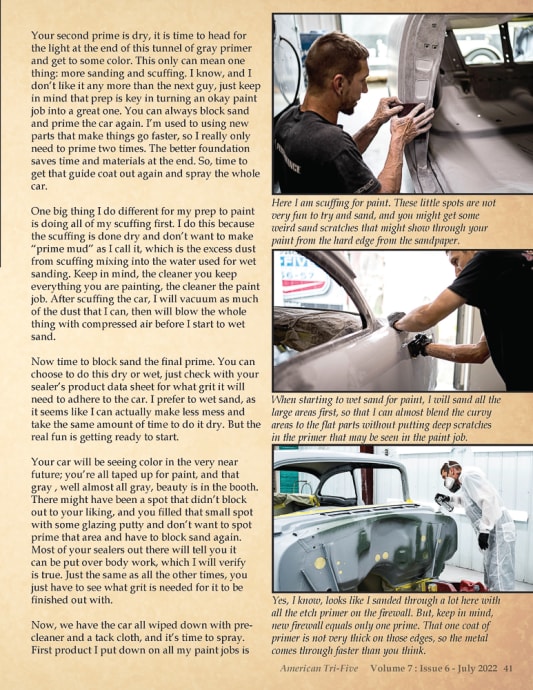
Page 6: Top: Here I am scuffing for paint. These little spots are not very fun to try and sand, and you might get some weird sand scratches that might show through your paint from the hard edge from the sandpaper.
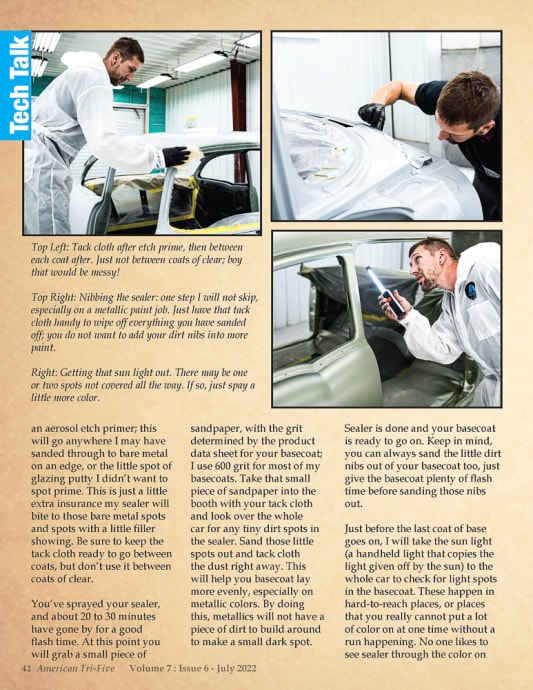
Middle: When starting to wet sand for paint, I will sand all the large areas first, so that I can almost blend the curvy areas to the flat parts without putting deep scratches in the primer that may be seen in the paint job.
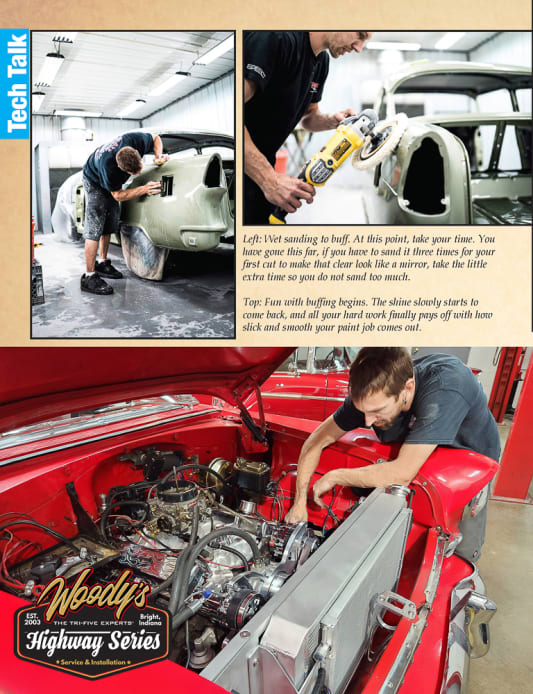
Bottom: Yes, I know, looks like I sanded through a lot here with all the etch primer on the firewall. But, keep in mind, new firewall equals only one prime. That one coat of primer is not very thick on those edges, so the metal comes through faster than you think.
Page 7: Top Left: Tack cloth after etch prime, then between each coat after. Just not between coats of clear; boy that would be messy!
Top Right: Nibbing the sealer: one step I will not skip, especially on a metallic paint job. Just have that tack cloth handy to wipe off everything you have sanded off; you do not want to add your dirt nibs into more paint.
Right: Getting that sun light out. There may be one or two spots not covered all the way. If so, just spay a little more color.
Page 9: Left: Wet sanding to buff. At this point, take your time. You have gone this far, if you have to sand it three times for your first cut to make that clear look like a mirror, take the little extra time so you do not sand too much.
Top: Fun with buffing begins. The shine slowly starts to come back, and all your hard work finally pays off with how slick and smooth your paint job comes out.