Printed in The American Tri-Five magazine in Volume 8 : Issue 2
For a car that appears as big as it does, the engine bay of a Tri-Five can certainly leave something to be desired in the room department. Whether you’re stuffing a big block between the fenders, adding an LS to the mix, or even so much as running a SBC with tall valve covers or larger distributor, extra space is definitely not in surplus by any means.
So, what’s there to do when you run out of room? You have the option to go forward, but this is generally minimal. Most bolt-in aftermarket mount setups typically offer ¾” of movement forward, and any more than that starts to cause other problems anyways, mainly with the drag link for the steering and clearance for such to the oil pan.
You could theoretically go backwards as much as you wanted to, but there’s a pesky firewall in the way…or is there?
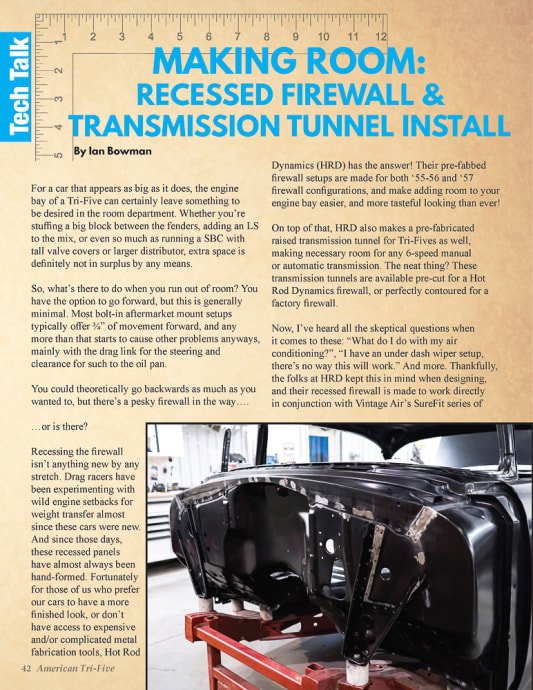
Recessing the firewall isn’t anything new by any stretch. Drag racers have been experimenting with wild engine setbacks for weight transfer almost since these cars were new. And since those days, these recessed panels have almost always been hand-formed. Fortunately for those of us who prefer our cars to have a more finished look, or don’t have access to expensive and/or complicated metal fabrication tools, Hot Rod Dynamics (HRD) has the answer! Their pre-fabbed firewall setups are made for both ‘55-56 and ‘57 firewall configurations, and make adding room to your engine bay easier, and more tasteful looking than ever!
On top of that, HRD also makes a pre-fabricated raised transmission tunnel for Tri-Fives as well, making necessary room for any 6-speed manual or automatic transmission. The neat thing? These transmission tunnels are available pre-cut for a Hot Rod Dynamics firewall, or perfectly contoured for a factory firewall.
Now, I’ve heard all the skeptical questions when it comes to these: “What do I do with my air conditioning?”, “I have an under dash wiper setup, there’s no way this will work.” And more. Thankfully, the folks at HRD kept this in mind when designing, and their recessed firewall is made to work directly in conjunction with Vintage Air’s SureFit series of evaporators for Tri-Fives, as well as being compatible with Raingear wipers. So, even though room has been created, crucial room has not been sacrificed in other areas. Frankly, you can have your cake and eat it to!
Let’s move on to the install!
Here at Woody’s, we offer the Hot Rod Dynamics firewall (P/N HRD-5556 or HRD-57) as an option on our All-New Tri-Five bodies. For the caliber of car these bodies are typically built into, the smooth firewall is a popular option for a clean look. You’ll need the front clip out of the way in order to access everything you need to, as well as everything removed from under the dash. As empty as possible makes everything as safe and easy as possible.
The firewall braces need to be removed and drilling the spot welds is by far the easiest way to do so. Just like doing the floors, a 5/16” drill bit is the weapon of choice here. They should be fairly visible.
Work your way down, and once it’s loose, you can simply bend them out of the way. If you’re *really* ambitious, or like a super clean look, you can trim these back to just above the toeboard.
With the braces loose, take a scribing tool and mark the location of the hood hinge holes on the upper cowl area. The HRD firewall doesn’t have these holes pre-located, and we’ll need to drill them after the fact. More on this later…
Move to the bottom, and scribe roughly ½” above the toeboard section. You’ll need this to weld to!
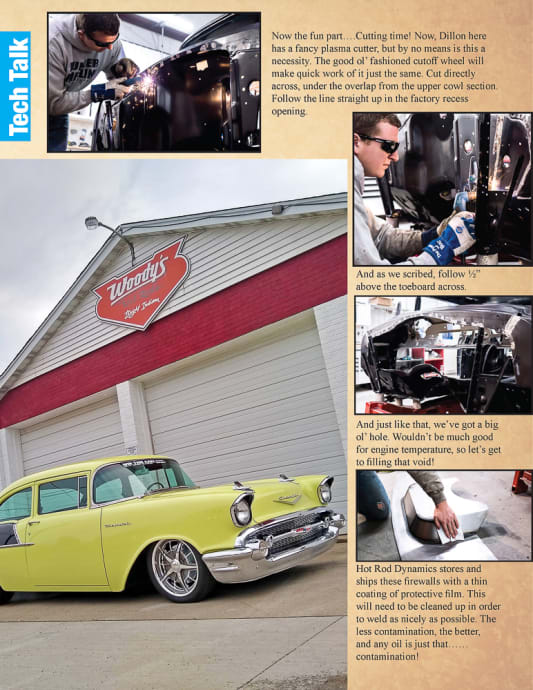
Now the fun part….Cutting time! Now, Dillon here has a fancy plasma cutter, but by no means is this a necessity. The good ol’ fashioned cutoff wheel will make quick work of it just the same. Cut directly across, under the overlap from the upper cowl section. Follow the line straight up in the factory recess opening.
And as we scribed, follow ½” above the toeboard across.
And just like that, we’ve got a big ol’ hole. Wouldn’t be much good for engine temperature, so let’s get to filling that void!
Hot Rod Dynamics stores and ships these firewalls with a thin coating of protective film. This will need to be cleaned up in order to weld as nicely as possible. The less contamination, the better, and any oil is just that……contamination!
The first view of the firewall shows just how much room gets opened up here, and just how slicked up the frame winds up.
Now, this is one place that buying a HRD firewall through Woody’s only makes sense: since we install these in house in just about every other body we build, we have a template made for drilling crucial holes. And we’re happy to share it! The template locates off the two holes in the toeboard used to mount the column. You’ll want to offset the firewall +/- 1/4” to the passenger side, as this will 100% guarantee that your brake backbone and master/booster doesn’t end up in the recess. This offset will be completely unnoticeable, even for the most OCD of installer.
You’ll want to notch the toeboard for the firewall to slip into once left – right orientation is determined. This will keep it centered.
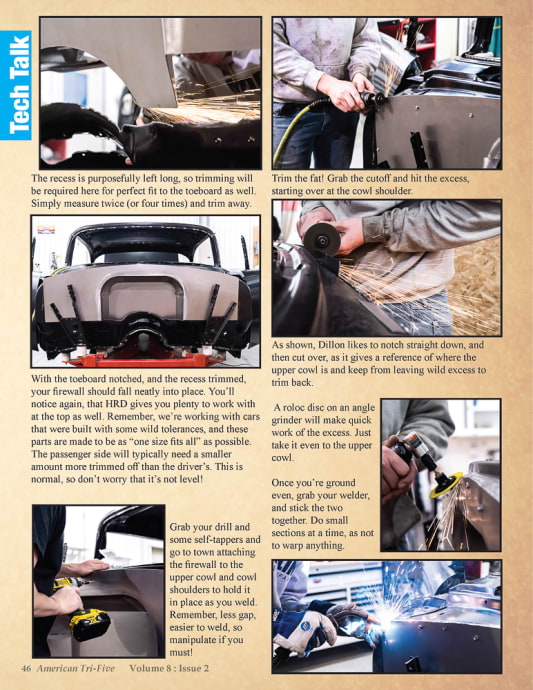
The recess is purposefully left long, so trimming will be required here for perfect fit to the toeboard as well. Simply measure twice (or four times) and trim away.
With the toeboard notched, and the recess trimmed, your firewall should fall neatly into place. You’ll notice again, that HRD gives you plenty to work with at the top as well. Remember, we’re working with cars that were built with some wild tolerances, and these parts are made to be as “one size fits all” as possible. The passenger side will typically need a smaller amount more trimmed off than the driver’s. This is normal, so don’t worry that it’s not level!
Grab your drill and some self-tappers and go to town attaching the firewall to the upper cowl and cowl shoulders to hold it in place as you weld. Remember, less gap, easier to weld, so manipulate if you must!
Trim the fat! Grab the cutoff and hit the excess, starting over at the cowl shoulder.
As shown, Dillon likes to notch straight down, and then cut over, as it gives a reference of where the upper cowl is and keep from leaving wild excess to trim back.
A roloc disc on an angle grinder will make quick work of the excess. Just take it even to the upper cowl.
Once you’re ground even, grab your welder, and stick the two together. Do small sections at a time, as not to warp anything.
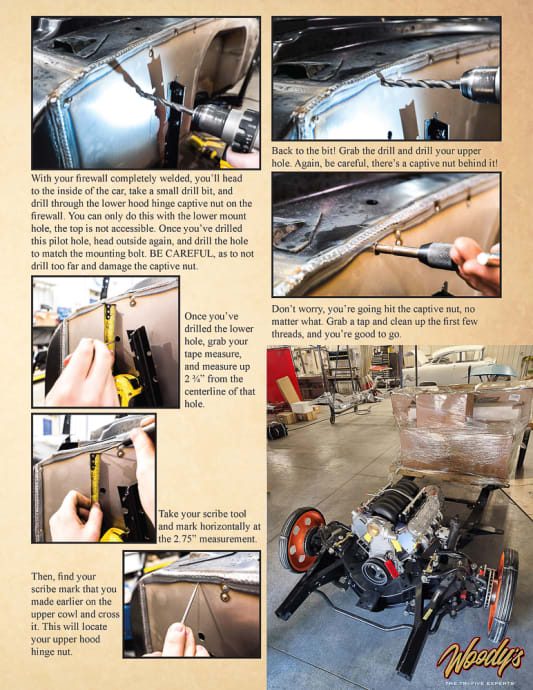
With your firewall completely welded, you’ll head to the inside of the car, take a small drill bit, and drill through the lower hood hinge captive nut on the firewall. You can only do this with the lower mount hole, the top is not accessible. Once you’ve drilled this pilot hole, head outside again, and drill the hole to match the mounting bolt. BE CAREFUL, as to not drill too far and damage the captive nut.
Once you’ve drilled the lower hole, grab your tape measure, and measure up 2 ¾” from the centerline of that hole.
Take your scribe tool and mark horizontally at the 2.75” measurement.
Then, find your scribe mark that you made earlier on the upper cowl and cross it. This will locate your upper hood hinge nut.
Back to the bit! Grab the drill and drill your upper hole. Again, be careful, there’s a captive nut behind it!
Don’t worry, you’re going hit the captive nut, no matter what. Grab a tap and clean up the first few threads, and you’re good to go.
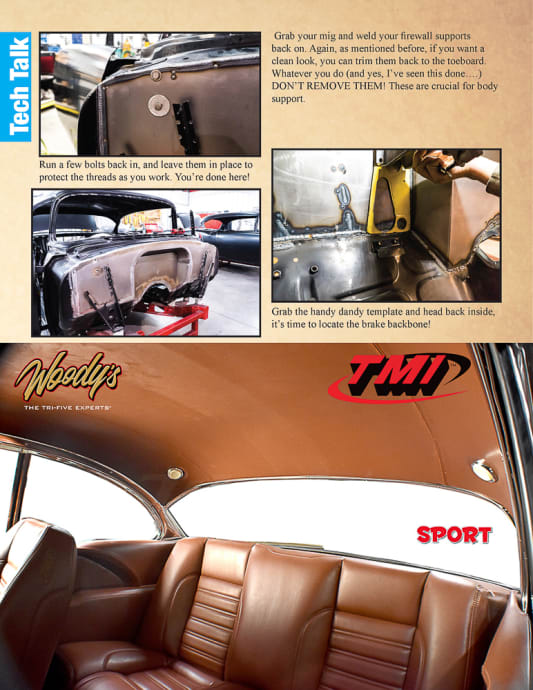
Run a few bolts back in, and leave them in place to protect the threads as you work. You’re done here!
Grab your mig and weld your firewall supports back on. Again, as mentioned before, if you want a clean look, you can trim them back to the toeboard. Whatever you do (and yes, I’ve seen this done….) DON’T REMOVE THEM! These are crucial for body support.
Grab the handy dandy template and head back inside, it’s time to locate the brake backbone!
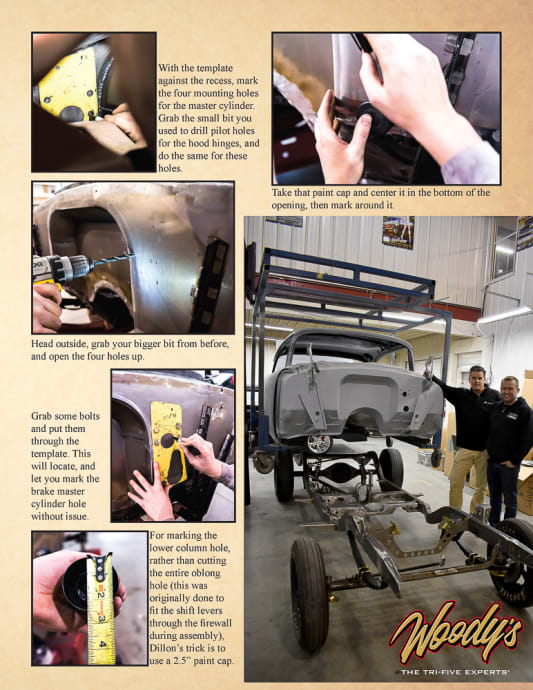
With the template against the recess, mark the four mounting holes for the master cylinder. Grab the small bit you used to drill pilot holes for the hood hinges, and do the same for these holes.
Head outside, grab your bigger bit from before, and open the four holes up.
Grab some bolts and put them through the template. This will locate, and let you mark the brake master cylinder hole without issue.
For marking the lower column hole, rather than cutting the entire oblong hole (this was originally done to fit the shift levers through the firewall during assembly), Dillon’s trick is to use a 2.5” paint cap.
Take that paint cap and center it in the bottom of the opening, then mark around it.
Remove the template, and you’ll see both the holes for your brake and column clearly marked. Time to make more holes!
Grab your tape measure, and find the center of each circle, the snap both with the centerpunch.
Remember that small bit? Grab that guy again and make a pilot hole in each.
Feeling holy! Grab the matching hole saw to the template and drill your brake hole.
…then, grab your bigger hole saw, and do your column. And just like that, your firewall is wrapped up!
Now, to move to the inside. As you can see, the factory transmission tunnel isn’t much of a rise. It’s not hard to see how any kind of a taller transmission would be a problem. For what it’s worth, any of the GM 4-speed automatics or 5 speed manuals will fit the tunnel without modification.
And with the HRD Transmission tunnel laid in place, you can see this is world of difference! Nice thing as well, HRD offers this tunnel cut for a factory firewall as well, for those not doing one of their recessed setups.
Being as these are matched components from the same manufacturer, the fit straight out of the box is everything you could want it to be!
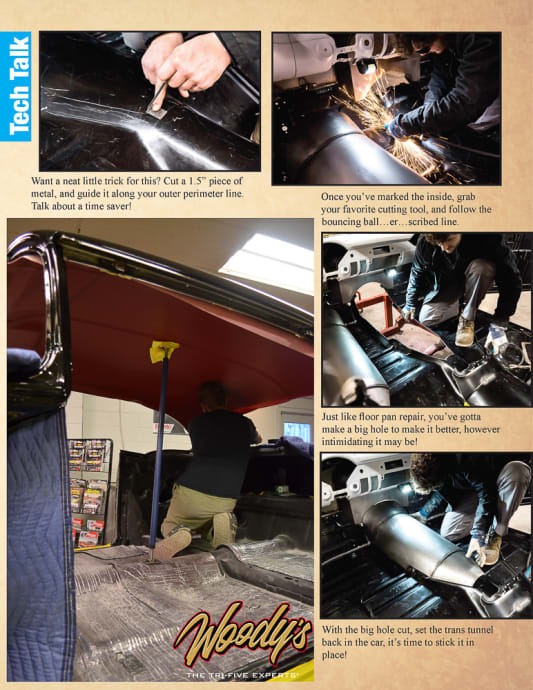
Grab your scribe tool, and mark the floor around the outer perimeter of the trans tunnel. This is especially easy with the EDP on the new floor pans, as it shows up well. If your floor is a touch dingy, simply use your favorite marking tool.
If you read last month’s floor pan replacement, this ought to look familiar to you: Measure in roughly 1 ½” and mark your floor again. This will give you metal to work with while installing the tunnel, and insure it doesn’t get cut back too short.
Want a neat little trick for this? Cut a 1.5” piece of metal, and guide it along your outer perimeter line. Talk about a time saver!
Once you’ve marked the inside, grab your favorite cutting tool, and follow the bouncing ball…er…scribed line.
Just like floor pan repair, you’ve gotta make a big hole to make it better, however intimidating it may be!
With the big hole cut, set the trans tunnel back in the car, it’s time to stick it in place!
With a small amount of pressure applied, tack the tunnel in place in a few spots to prevent it from “walking” as you work your way around.
From there, you can work the tunnel all the way around, welding small sections at a time to keep warpage to a minimum. Granted we’re not doing bodywork here; it’ll simply keep your tunnel as straight as possible while working.
With the top welded, it’s time to head to the bottom!
A few relief cuts will need to be made to bring the floor up against the transmission tunnel.
And with the floor fully welded, you’re ready for however your firewall and/or floor pan is to be bodyworked, with all the room for bigger and better power!