Printed in The American Tri-Five magazine in Volume 8 : Issue 3
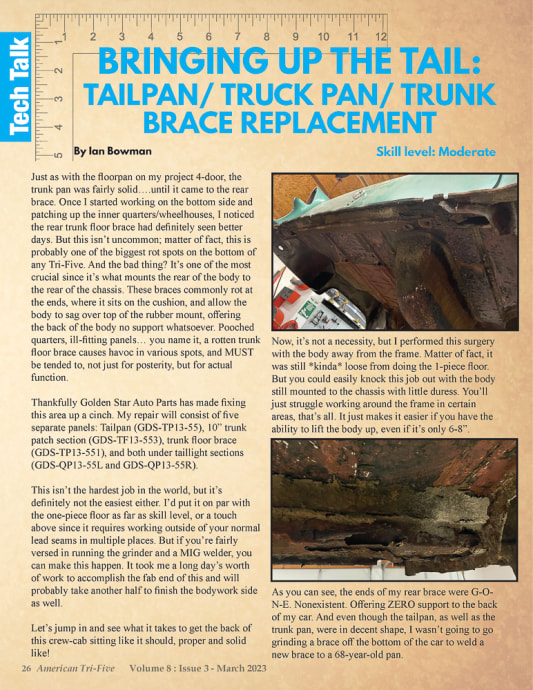
Just as with the floorpan on my project 4-door, the trunk pan was fairly solid….until it came to the rear brace. Once I started working on the bottom side and patching up the inner quarters/wheelhouses, I noticed the rear trunk floor brace had definitely seen better days. But this isn’t uncommon; matter of fact, this is probably one of the biggest rot spots on the bottom of any Tri-Five. And the bad thing? It’s one of the most crucial since it’s what mounts the rear of the body to the rear of the chassis. These braces commonly rot at the ends, where it sits on the cushion, and allow the body to sag over top of the rubber mount, offering the back of the body no support whatsoever. Pooched quarters, ill-fitting panels… you name it, a rotten trunk floor brace causes havoc in various spots, and MUST be tended to, not just for posterity, but for actual function.
Thankfully Golden Star Auto Parts has made fixing this area up a cinch. My repair will consist of five separate panels: Tailpan (GDS-TP13-55), 10” trunk patch section (GDS-TF13-553), trunk floor brace (GDS-TP13-551), and both under taillight sections (GDS-QP13-55L and GDS-QP13-55R).
This isn’t the hardest job in the world, but it’s definitely not the easiest either. I’d put it on par with the one-piece floor as far as skill level, or a touch above since it requires working outside of your normal lead seams in multiple places. But if you’re fairly versed in running the grinder and a MIG welder, you can make this happen. It took me a long day’s worth of work to accomplish the fab end of this and will probably take another half to finish the bodywork side as well.
Let’s jump in and see what it takes to get the back of this crew-cab sitting like it should, proper and solid like!
Now, it’s not a necessity, but I performed this surgery with the body away from the frame. Matter of fact, it was still *kinda* loose from doing the 1-piece floor. But you could easily knock this job out with the body still mounted to the chassis with little duress. You’ll just struggle working around the frame in certain areas, that’s all. It just makes it easier if you have the ability to lift the body up, even if it’s only 6-8”.
As you can see, the ends of my rear brace were G-O-N-E. Nonexistent. Offering ZERO support to the back of my car. And even though the tailpan, as well as the trunk pan, were in decent shape, I wasn’t going to go grinding a brace off the bottom of the car to weld a new brace to a 68-year-old pan.
…. Ok, maybe there wasn’t all the trunk pan there to weld to anyways. The 10” patch started to make real sense with this extra ventilation hole present from the top as well.
Five simple pieces make this job very straightforward. Believe me when I say that I’m more than thankful companies like Golden Star exist to make my life easier.
If you have a rusty tailpan, you were gonna replace it. If you don’t….well….you’re gonna replace it anyways. Accessing the trunk floor without the tailpan removed would be difficult (read: impossible). So, mocking up and marking where the pan comes to will give us a reference.
Grab your favorite marking device and mark all the way to the tailpan’s edge. Remember, these will be overlapped areas. In the event you had very nice corners, you could burn the lead out, and leave the corners intact, thus not needing the QP13-55R/L panels. Mine, however, were far from perfect, if that little blister shown was indication enough, but more on that later.
Other side shows repair necessary all the same, but we’re starting simply where the tailpan ends.
I marked the trunk floor right at the ledge, as I’ll overlap the two panels, and seam seal the two underneath to finish it off.
Time to make a big ol’ hole! I’m a fan of a large diameter cutoff wheel for removing the rusty pieces, but your favorite metal cutting device should make quick work of it. Remember, if you’re working over top of the frame, don’t cut too far down!!!
I cut inside of the lines, to ensure that no matter what, I’m not taking off too much metal to start. We’ll finish trim this when we’re not fighting the entire tailpan area coming loose.
Then, move onto the trunk floor, working your way across.
And just like that, your tailpan, brace,
and trunk floor section are out. DO NOT THROW THIS AWAY YET! You’ll need the striker, guide plate, and latch plate later on!!!
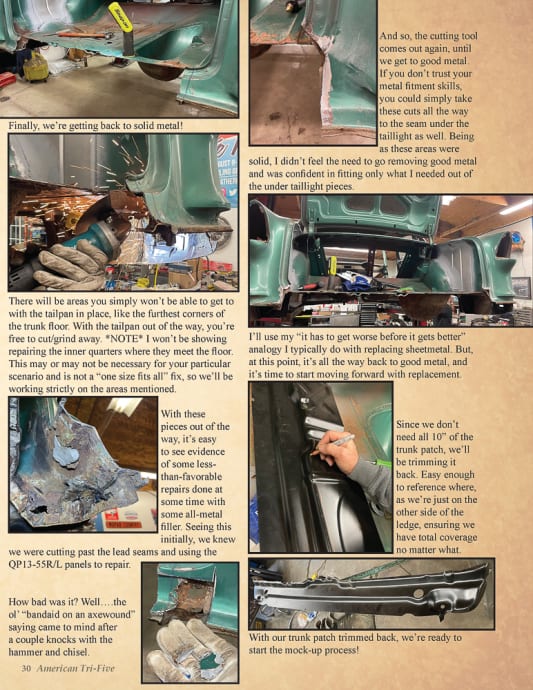
Finally, we’re getting back to solid metal!
There will be areas you simply won’t be able to get to with the tailpan in place, like the furthest corners of the trunk floor. With the tailpan out of the way, you’re free to cut/grind away. *NOTE* I won’t be showing repairing the inner quarters where they meet the floor. This may or may not be necessary for your particular scenario and is not a “one size fits all” fix, so we’ll be working strictly on the areas mentioned.
With these pieces out of the way, it’s easy to see evidence of some less-than-favorable repairs done at some time with some all-metal filler. Seeing this initially, we knew we were cutting past the lead seams and using the QP13-55R/L panels to repair.
How bad was it? Well….the ol’ “bandaid on an axewound” saying came to mind after a couple knocks with the hammer and chisel.
And so, the cutting tool comes out again, until we get to good metal. If you don’t trust your metal fitment skills, you could simply take these cuts all the way to the seam under the taillight as well. Being as these areas were solid, I didn’t feel the need to go removing good metal and was confident in fitting only what I needed out of the under taillight pieces.
I’ll use my “it has to get worse before it gets better” analogy I typically do with replacing sheetmetal. But, at this point, it’s all the way back to good metal, and it’s time to start moving forward with replacement.
Since we don’t need all 10” of the trunk patch, we’ll be trimming it back. Easy enough to reference where, as we’re just on the other side of the ledge, ensuring we have total coverage no matter what.
With our trunk patch trimmed back, we’re ready to start the mock-up process!
Helpful tip: bending the end corners in will help get the rear patch into place. Once the pan is where it needs to be, these can be tapped over with a hammer to meet your inner quarters.
With the pan slid into place, check fit to the floor and quarters, and make adjustments to either the floor, the inner quarter, or the patch accordingly to obtain the fit you desire. This one required some work in the corner areas to get 110% but was good to go other than that.
The original lacquer paint is NOT nice to weld through at all and will easily contaminate any weld you make against it. So, get your floor side as clean as possible before welding.
Go ahead and put a couple tacks in your patch, starting at the corners to keep things in place.
Go ahead and work your way across with a few more tacks. If you’re working by yourself, and/or your frame is out of the way, a floor jack and a 4x4 makes handy for getting both panels to mate up without an extra pair of hands in the mix. Work back and forth, to make sure you don’t have excessive warpage as you weld.
Pan’s welded in, time to fit up our corners!
You’ll notice we cut down the corner to start; the lip at the factory seam makes fitting these to the quarter to begin with extremely difficult. Removing it lets the patch lay nice to the quarter.
All we did was figure out where we would be on the opposite side of our cut on the body to start with. Once that is figured out, simply figure out where you need to be in the trunk channel and mark your patch to get it down to proper size.
With your panel trimmed down, lay it in the channel and mark the body side. This will effectively give us two matching surfaces to mate the panels together.
Body is marked, effectively showing where the two panels will mate, and getting us into good metal for a solid repair that will last for decades to come.
Grab that cutoff wheel and cut your body to match the panel. Be careful not to cut too far into the body like I did, it’ll be less to weld up and bodywork when you’re done! If your inner quarter is in good shape, you can cut only through the outer quarter layer and save the inner section. Once cut, grab your patch and tack into place. Be sure to drop your decklid and make sure you’re at least in the ballpark.
If your fit is satisfactory, at least enough to start (remember, the entire quarter section is still loose here and will ultimately be dictated mostly by the tailpan), you can weld the corner patch in. WORK SLOWLY. Tack….and wait. Tack….and wait. Otherwise, this panel WILL warp and require excessive bodywork.
Process is repeated on the passenger side, though slightly more needed to be taken out to get to good metal over here thanks to the rough spot by the lead seam shown in pictures 15 and 16.
Again, I cannot stress this enough: DO NOT RUSH while welding. Spot and let it cool.
With our corners tended to, it’s time to start fitting the tailpan. Take note, these small tabs may require some bending to get the tailpan to set in place perfectly. But don’t fear; these are only there to hold the rear body to bumper seal.
Fit right out of the gate isn’t terrible by any means. Remember that this area was filled with lead to start with, so there will inherently be a low spot until body worked. We’re going to fully weld this area instead of doing any spotting, and we will poly-fill it during the bodywork process for a final fit that will last a lifetime and won’t ever pop back through like lead.
Fit left to right and top to bottom looks good. Golden Star really could not have made this panel any better, no complaints from my end at all!
With initial fit set, put a couple tacks in place.
Remember that all panels are different, and some massaging may be required for final fitment. Our corners and tailpan required VERY minimal prodding to fit as nice as possible.
With your tailpan tacked into place, you’ll want to check your decklid fitment. This car isn’t a show car, but I wanted the gaps fairly even. If there’s an issue here, it’s easy enough to knock the tack off, spread or pull in the quarter, and re-tack.
Happy with your fitment? Then go ahead and weld the tailpan in all the way. Remember, slow and steady wins the race….and makes for less to fix in post!
Once your tailpan is welded, you can finish weld the trunk patch to the trunk floor. Remember our 4x4/jack trick, and a hammer will make easy work here. Only a small amount of grinding/filler will be required to finish this edge off, making the seam invisible without the pain of butting two panels together.
With our tailpan welded, it’s time to move on to our lower brace. If you’re working with the body off the frame, it’s time to bring the frame back into play. If it was there all along, you’ll simply want to set your rear mount cushions on the frame (as shown here) and grab your rear trunk brace.
For the “body off” crowd: once lined up, set the body down onto the brace, full weight. Check your body mount alignment not only at the rear, but in multiple points across the body to ensure fitment all around. THIS IS CRUCIAL, unless you like your body crooked on the frame.
Check your left to right
once weight is on.
Once your brace is where you like it, go ahead and tack it on, and then tack the trunk patch to the tailpan while you’re down here.
With our brace tackled, it’s down to the final steps: trunk latch! The one from my car was in good shape, so I chose to reuse it. However, if you’re looking to save yourself some time, Golden Star makes a kit for this to be replaced with new pieces: P/N GDS-TL13-55LS and GDS-TL13-55A.
Cleanup is probably the biggest pain in the rear with removing this guy; GM put a TON of seam sealer here. Why? I’m not sure I know, but a chisel and hammer got it taken care of.
With the seam sealer out of the way, the welds on the sides will be exposed. Simply grind these away, and you should be able to pop it free from the old trunk floor. Trunk lid alignment tab is held on in similar fashion.
The back flat is spot welded. Grab a 5/16 drill bit and drill these out. The upper support to the tailpan is also spotted, though I chose to cut the tailpan and grind those back to leave as much metal available as possible.
With your latch plate support and alignment tabs removed, take them over to your newly repaired panels and begin fitment.
I chose to make a mark on the decklid for the latch to help center my support. Thankfully, I don’t have OCD, as the centerline wasn’t even close to the license plate holes. Such is life when working on a 68-year-old car!
With our centerline established, put a couple tacks onto the support, and install the striker plate. From here, you’ll want to shut the decklid and make sure fit is up to par.
Our fit was good right out of the gate, so finish weld we did!
Grab your alignment pin tab and locate it to the body using the same method as the latch.
Tack in place and check alignment. This step took a few times of trial and error to get 100%, so don’t be discouraged!
Boom! We’re ready to latch and lock.
And we’re back to having good metal in the tail section. This was the last step of the metalwork process for this car, so it’s into the booth for bodywork now. Look for this one in further articles down the line!