Printed in The American Tri-Five magazine in Volume 8 : Issue 9
If driving your Tri-Five is part of the plan, one of the most important aspects to consider are the tires. Not only are they a crucial part of your car’s personality, but they also determine the driving characteristics, which can really make or break the fun factor of your old Chevy. Like any aspect of your build, the tires are purely a matter of preference, but there are a few ways to tackle the decision. The topic of bias ply versus radial tires only applies to a portion of the Tri-Five audience, as many folks opt for a more modern 17-inch or larger wheel with tires you can get at the local shop. However, there are plenty of Tri-Five owners who want the original wide whitewall look, or at least something close to stock. Additionally, this topic can have great value for gasser and nostalgia drag racing enthusiasts, as tires are a crucial part of nailing the period correct appearance.
We hope to point you in the right direction with some educational tidbits regarding tires, specifically the differences between bias ply tires and radial tires, and how to go about choosing the proper tires for your Tri-Five.
Bias Ply Tires
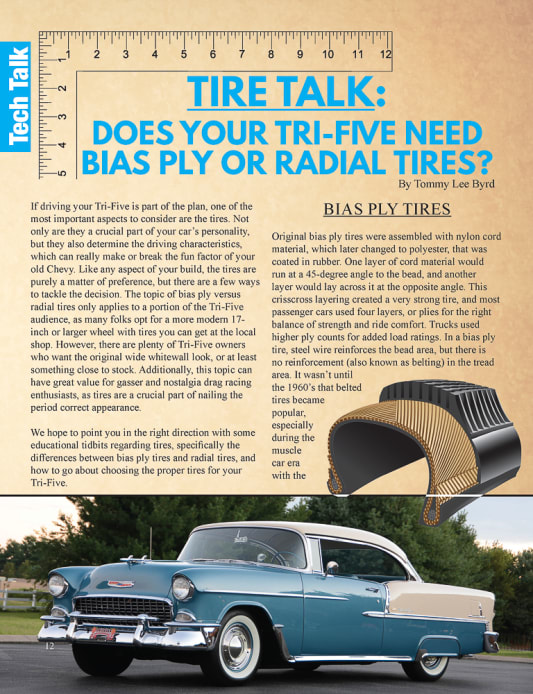
Original bias ply tires were assembled with nylon cord material, which later changed to polyester, that was coated in rubber. One layer of cord material would run at a 45-degree angle to the bead, and another layer would lay across it at the opposite angle. This crisscross layering created a very strong tire, and most passenger cars used four layers, or plies for the right balance of strength and ride comfort. Trucks used higher ply counts for added load ratings. In a bias ply tire, steel wire reinforces the bead area, but there is no reinforcement (also known as belting) in the tread area. It wasn’t until the 1960’s that belted tires became popular, especially during the muscle car era with the inception of Firestone Wide Oval and Goodyear Polyglas tires.
A common misconception is that all bias ply tires require a tube. While tubes are necessary on wire wheels and some types of riveted steel wheels, most tires from the 1950’s and beyond are designed to be run tubeless. In all reality, it is usually the wheel that determines whether you need to run tubes, regardless of bias ply or radial tire construction.
When it comes to ride quality, a bias ply tire’s internal construction causes some unusual behavior, especially if you’ve grown accustomed to modern suspension and radial tires. Bias ply tires often have a very small contact patch, and the construction style doesn’t allow the load to spread very far in the tire’s structure. These factors cause the tire search and find imperfections in the road surface, which translate to a wandering feeling when you’re behind the wheel. A seasoned bias ply driver knows to let the car do its thing, because correcting will only make the sensation worse. Make no mistake, modern bias ply tires, produced by companies like Coker Tire, are safe to use, but they do offer a peculiar ride quality that doesn’t always please the end user.
Radial Tires
Michelin was the forerunner in radial tire technology, going all the way back to the original X radial tire that came out in 1949. These early radials were designed for European cars, and it took more than 20 years to catch on in the American market. Even then, many car enthusiasts stuck with bias ply tires well into the 1980’s because radials had reliability issues early on.
Radial tire construction means that the ply materials are arranged along the radius of the bead. The ply cords run at a 90-degree angle to the bead, giving the tire great flexibility. This design reduces rolling resistance and road noise, and it also softens the ride. Steel belting is added beneath the tread surface to strengthen the tire and give it stability going down the road. All these things add up to a tire that goes straight down the road, skimming over the imperfections of the pavement. Radial tires do not wander, so once the design was accepted by car enthusiasts, it became quite common to replace bias ply tires with modern radials.
Despite the obvious improvements in ride quality and handling, the appearance of a radial didn’t mesh well with original restored cars. This was especially true because radials were not available with an original-style wide whitewall. All you could get were white letters or a narrow whitewall, and neither of those options pleased the folks who wanted a somewhat original look. It wasn’t until Coker Tire invented the wide whitewall radial in 1994 that Tri-Five enthusiasts could have a true wide whitewall tire with smooth-riding radial construction. Coker Tire struck gold with the Coker Classic radial, and it’s still one of its most popular products nearly 30 years later. Coker Tire took it one step further in 2013 with the introduction of the American Classic “bias look radial”, a tire that has the authentic piecrust look with the stability of a modern radial. Coker offers the bias look radial in 670R15 and 750R14 sizes for Tri-Fives.
Much like the evolution of bias ply tires, radial tires have been refined and improved over the years. That means more performance, more sizes for custom builds and more brand options to fit your tastes. For those that want the restomod or Pro Touring look, there are endless tire size options to create the perfect combination.
Size Conversion
Most bias ply tires use a numeric sizing style, such as 6.70-15, which translates to a tire that is 6.70 inches wide and accepts a 15-inch wheel. When belted tires hit the scene around 1967, alphanumeric sizing hit the scene with sizes like F78-14. The letter designated the load rating, which also correlated with the width of the tire, while the “78” designated the aspect ratio. P-Metric was the next sizing convention to enter the tire industry and it threw everyone for a loop. The “P” stands for passenger car, and the series of numbers includes the section width in millimeters, the aspect ratio as a percentage, the letter “R” to designate radial and the final two numbers is the wheel diameter in inches. A P205/75R15, for example, has a 205mm overall width, and the sidewall is 75 percent of that width.
When it comes to converting a bias ply tire over to a radial, there is no foolproof way to do the math in your head. Luckily, companies like Coker Tire have enough fitment data to confirm bias ply to radial conversion sizes. For instance, a 1955 Chevy with a 6.70-15 bias ply tire will typically use a 205/75R15, while a 1957 Chevy with a 7.50-14 bias ply tire will use a 205/75R14 P-metric radial. Coker Tire took a unique approach with the bias look radial tire we mentioned earlier by using bias ply sizing, but adding an R designator in the sizing, ex. 670R15.
Bias ply to radial conversions are pretty simple in the Tri-Five world because there are two basic sizes, but custom sizing often require careful measurements to ensure proper fitment.
How to Choose
If you’re buying specialty tires for your Tri-Five, it’s going to cost significantly more than tires you can get at the local department store. If you’re building a restored car that’s going for points at an AACA or other scored event, bias ply tires are the proper choice. At the Tri-Five Nationals, there isn’t a points system, but the staff always appreciates an all-original car that rolls on authentic bias ply tires. Nothing beats the tall and skinny look of a bias ply tire, but there is a night-and-day difference in the ride quality between the authentic bias ply and a modern radial.
Radials are a great option for a car that looks stock but has a few hidden upgrades. Let’s say you’ve upgraded brakes, added A/C, and a few other aftermarket goodies—radial tires are the best option for your comfort. If you go with a wide whitewall, you’ll still get the look, but radial construction will give it a smooth ride down the road. Radial tires typically balance a little easier than bias ply tires, but they can be permanently damaged from flat-spotting during long term storage. Bias ply tires may also get flat spots, but they will heat up and return to the round shape after several miles of driving.
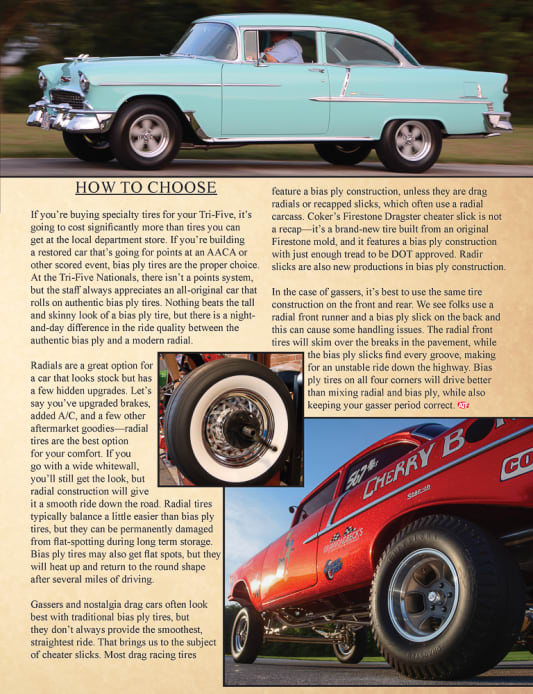
Gassers and nostalgia drag cars often look best with traditional bias ply tires, but they don’t always provide the smoothest, straightest ride. That brings us to the subject of cheater slicks. Most drag racing tires feature a bias ply construction, unless they are drag radials or recapped slicks, which often use a radial carcass. Coker’s Firestone Dragster cheater slick is not a recap—it’s a brand-new tire built from an original Firestone mold, and it features a bias ply construction with just enough tread to be DOT approved. Radir slicks are also new productions in bias ply construction.
In the case of gassers, it’s best to use the same tire construction on the front and rear. We see folks use a radial front runner and a bias ply slick on the back and this can cause some handling issues. The radial front tires will skim over the breaks in the pavement, while the bias ply slicks find every groove, making for an unstable ride down the highway. Bias ply tires on all four corners will drive better than mixing radial and bias ply, while also keeping your gasser period correct.