Printed in The American Tri-Five magazine in Volume 9 : Issue 2
The nuclear age brought many advancements in technology after WWII that revolutionized the way Americans lived their daily lives. A car or two, in every driveway, televisions in every family’s living room, jet planes replacing ground transportation for long distance travel, advancements in medicine, science, space exploration, and more transformed the way every American lived in the 1950s and ever since.
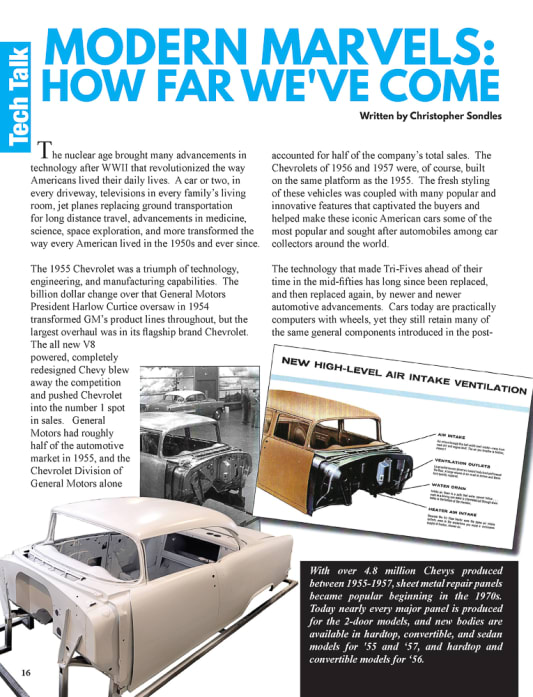
The 1955 Chevrolet was a triumph of technology, engineering, and manufacturing capabilities. The billion dollar change over that General Motors President Harlow Curtice oversaw in 1954 transformed GM’s product lines throughout, but the largest overhaul was in its flagship brand Chevrolet. The all new V8 powered, completely redesigned Chevy blew away the competition and pushed Chevrolet into the number 1 spot in sales. General Motors had roughly half of the automotive market in 1955, and the Chevrolet Division of General Motors alone accounted for half of the company’s total sales. The Chevrolets of 1956 and 1957 were, of course, built on the same platform as the 1955. The fresh styling of these vehicles was coupled with many popular and innovative features that captivated the buyers and helped make these iconic American cars some of the most popular and sought after automobiles among car collectors around the world.
The technology that made Tri-Fives ahead of their time in the mid-fifties has long since been replaced, and then replaced again, by newer and newer automotive advancements. Cars today are practically computers with wheels, yet they still retain many of the same general components introduced in the post-war era. The automotive aftermarket has been very good for the Tri-Five Chevys over the years due in part to the sheer number of cars that have stayed on the road and continue to be brought back to life each year.
As we addressed in a very early issue of The American Tri-Five magazine, Chevrolet built 4.8 million cars over the three-year span, and it could easily be conceivable that more than 10% have survived for nearly 70 years. Consumer demand for parts for roughly a half million potential cars makes the producers of aftermarket parts pay close attention to our beloved Tri-Five Chevys and this helps keep parts flowing.
Today the sky is the limit for how a person can transform their Tri-Five into a modern marvel that has the styling of one of the most recognizable cars in history and the technology of a modern car. Cars in this issue are just an example of what can be accomplished using parts now available to us all.
In 1955 Chevrolet proudly promoted their all new 162hp V8 that was truly a milestone in automotive history. The $99 option gave the new Chevy the power that the jet age deserved. Consider this, a new out of the box base LS3 is rated at 430hp and while a new out of the crate LT4 boasts 650hp. These are not even modified engines; they are available straight from Chevrolet Performance.
Chevy was proud of the 2-speed Powerglide transmission that backed their new V8. Although available in some form between 1950 and 1973, the Powerglide was nothing comparable to the 4, 6, and even 8 speed automatic transmissions that are available for your hot rod today.
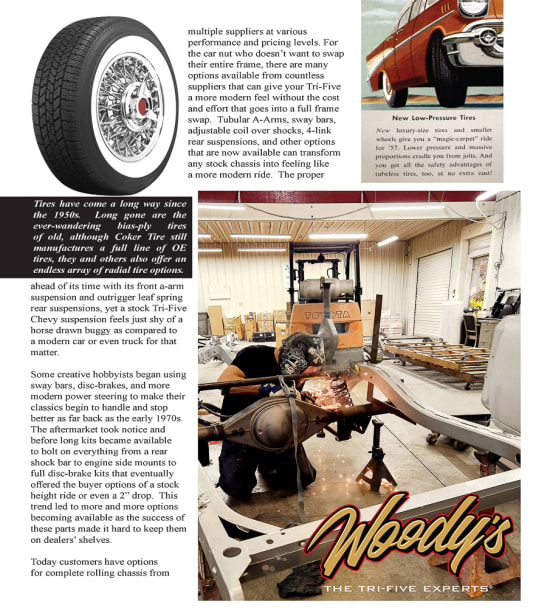
Beyond the obvious powertrain upgrades that have continued to inspire car guys to upgrade over the years is the clear advancements in suspension technology. The '55 was ahead of its time with its front a-arm suspension and outrigger leaf spring rear suspensions, yet a stock Tri-Five Chevy suspension feels just shy of a horse drawn buggy as compared to a modern car or even truck for that matter.
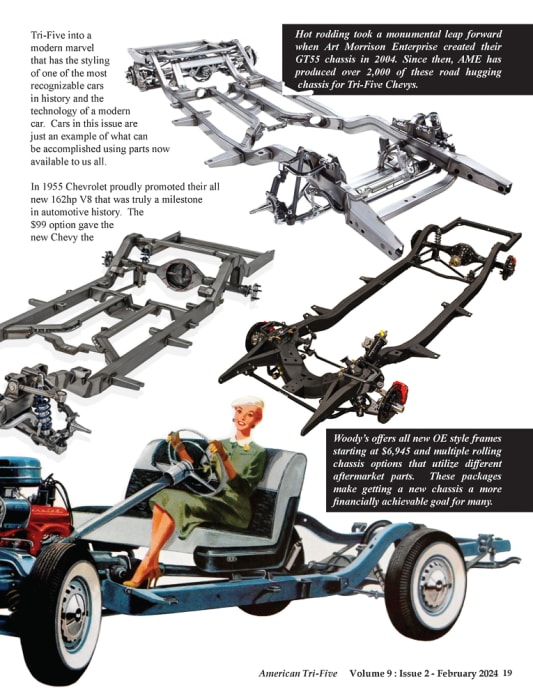
Some creative hobbyists began using sway bars, disc-brakes, and more modern power steering to make their classics begin to handle and stop better as far back as the early 1970s. The aftermarket took notice and before long kits became available to bolt on everything from a rear shock bar to engine side mounts to full disc-brake kits that eventually offered the buyer options of a stock height ride or even a 2” drop. This trend led to more and more options becoming available as the success of these parts made it hard to keep them on dealers’ shelves.
Today customers have options for complete rolling chassis from multiple suppliers at various performance and pricing levels. For the car nut who doesn’t want to swap their entire frame, there are many options available from countless suppliers that can give your Tri-Five a more modern feel without the cost and effort that goes into a full frame swap. Tubular A-Arms, sway bars, adjustable coil over shocks, 4-link rear suspensions, and other options that are now available can transform any stock chassis into feeling like a more modern ride. The proper combination of parts can give any owner the feel they are looking for at a variety of price points.
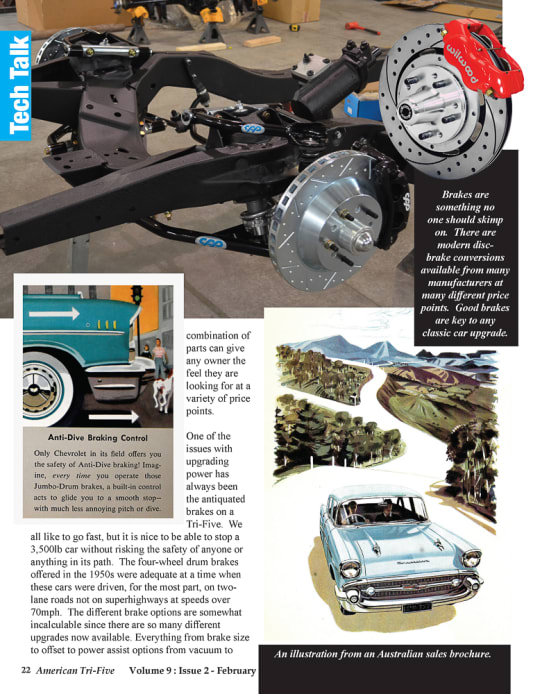
One of the issues with upgrading power has always been the antiquated brakes on a Tri-Five. We all like to go fast, but it is nice to be able to stop a 3,500lb car without risking the safety of anyone or anything in its path. The four-wheel drum brakes offered in the 1950s were adequate at a time when these cars were driven, for the most part, on two-lane roads not on superhighways at speeds over 70mph. The different brake options are somewhat incalculable since there are so many different upgrades now available. Everything from brake size to offset to power assist options from vacuum to hydra-boost and even electric assist brakes are now available to consumers. Good brakes are a must for these cars, and there are many options available for any budget.
Power steering was available in the 1950s, but it was a rare option. As with brakes, steering was not as big of an issue in the 1950s; tires were 5” wide, and steering wheels mimicked that of a Greyhound bus. Today Tri-Five lovers have an abundance of options when it comes to improving their ride’s steering. There are multiple tried and tested power steering box options, rack and pinion options, and even electric assist power steering available.
Steering options and upgrades continue into the interior with many different tilt and telescopic steering columns at a variety of different lengths, finishes, and other options. Steering wheels have always been an easy upgrade, and now many manufactures have jumped on board to get the customer the look and feel they’re looking for while several companies offer smaller versions of the OE GM steering wheels customizers have been using for years.
When you think about how these cars have been upgraded, modified, and reconstructed over the years, it is a true testament to all of us who have continued to support this hobby and the industry that fills our desires and needs to make classic iron drive, run, and feel like a new car.
With so many options and upgrades available how does the average car nut determine what is best for them? This is where it gets tricky. Car magazines have sure dried up, although there are still a few great options out there, including The American Tri-Five, of course. Car magazines used to line the shelves at the grocery store full of ideas, tech articles, and advice from the “pros”. Today, many folks rely on the world wide web to help steer them into or out of a purchase and upgrade for their car.
As with the magazine articles of days gone by, the web is full of biased ideas that may be misleading. Each company will tell you that their part is better than the other guys and why. This can also be somewhat self-serving and possibly misleading at times as well. The best advice we can give is to research by calling not only friends who have used the parts you need, but also talk directly to shops who have installed a variety of the parts available for these cars.
From trim items to mechanical parts, there are products that work, and then there are parts that just work better. Price has always contributed to these upgrade decisions as well, and today there are many great parts from off brand companies who have knocked off the name brand part. While some of these parts are good, some may not be worth the risk, but again, the customers’ budget will ultimately make these decisions.
In conclusion, I want to wrap up by saying that this is an awesome time to be crazy about old cars. There are so many great options to help make owning an old car safer, more comfortable, easier to operate, and ultimately more enjoyable for not only you but for the entire family. Do your research, call a friend or even call our tech line, we would be glad to help answer questions about what may be the best product at the best price for your classic.