Printed in The American Tri-Five magazine in Volume 9 : Issue 3
TRI-FIVE CHEVROLET COWL TAGS
Submitted, written, and photos supplied by Norm Smith member #1320, Denver, Colorado (edited for space and clarity.)
The cowl tag was the first item installed on a freshly built Chevy body. It is an approximately 3 ¾-inch by 2 ½-inch aluminum tag installed with aluminum rivets on the cowl or firewall of US built Tri-Five Chevrolet cars. It instructed the body assemblers through a series of codes to each body's specific paint scheme, interior color/pattern, and body “accessories” received. In this article, I will be cracking the codes.
The style line will start with the year of the car, then the model and series.
1955-57 - 150 models:
1211 2-Dr Sedan 1219 4-Dr Sedan
1211B Utility Sedan 1263F 2-Dr 6 Pass Wagon
1271 Sedan Delivery (55)
1955-57 - 210 Models:
1011 2-Dr Sedan 1019 4-Dr Sedan
1062F 4-Dr 6 Pass Wagon 1039 4-Dr Hardtop
1062FC 4-Dr 9 Pass Wagon 1011A Sedan (Del Ray)
1063F 2-Dr Pass Wagon 1037 2-Dr Hardtop
1955-57 Bel Air Models:
1011D 2-Dr Sedan 1019D 4-Dr Sedan
1062DF 4-Dr 6 Pass Wagon (56) 1039D 4-Dr Hardtop
1062DF 4-Dr 9 Pass Wagon 1064DF Nomad
1067D/or DTX Convertible 1037D 2-Dr Hardtop
The Body No (after the letters) is the number your body was in production. This number is unique and non-duplicating and started with the number '1' as the first body produced.
The letters on this line indicate the Fisher Body plant where the body was produced. There were twelve body assembly plants in the USA during the Tri-Five era. With their corresponding codes, they were:
Atlanta, GA (AG) Baltimore, MD (M)
Cleveland, OH (CL) Flint, MI (F)
Janesville, WI (J) Kansas City, MO (K)
Lansing, MI (L) Los Angeles, CA (VN)
Norwood, OH (N) Oakland, CA (O)
St. Louis, MO (S) Tarrytown, NY (T)
I believe all cowl tags were painted. GM would not have found masking individual tags to be cost effective. The original paint was applied to an aluminum surface that was exposed to engine heat, blow-by, (fuel, oil, coolant), weather extremes, road dirt, and other substances over 60-plus years.
There are also mistakes that show up on cowl tags; I'll be addressing a few. With the numbers of bodies produced, the number of differences from one body to the next, and the relative production speed, there are bound to be minor problems.
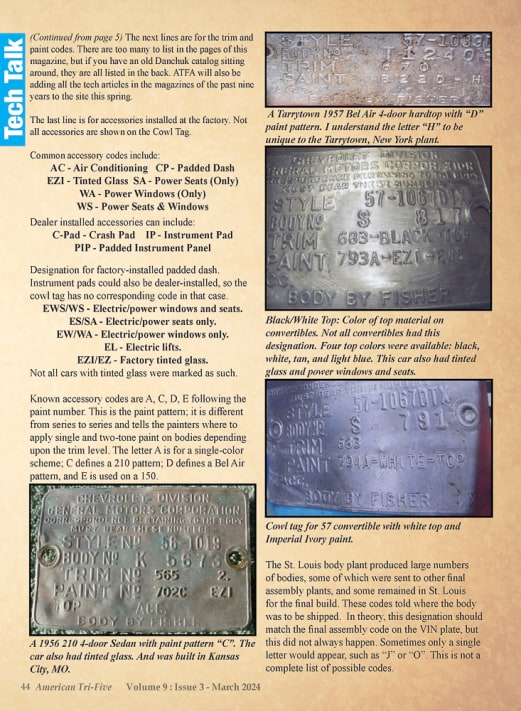
(Continued from page 5) The next lines are for the trim and paint codes. There are too many to list in the pages of this magazine, but if you have an old Danchuk catalog sitting around, they are all listed in the back. ATFA will also be adding all the tech articles in the magazines of the past nine years to the site this spring.
The last line is for accessories installed at the factory. Not all accessories are shown on the Cowl Tag.
Common accessory codes include:
AC - Air Conditioning CP - Padded Dash
EZI - Tinted Glass SA - Power Seats (Only)
WA - Power Windows (Only)
WS - Power Seats & Windows
Dealer installed accessories can include:
C-Pad - Crash Pad IP - Instrument Pad
PIP - Padded Instrument Panel
Designation for factory-installed padded dash. Instrument pads could also be dealer-installed, so the cowl tag has no corresponding code in that case.
EWS/WS - Electric/power windows and seats.
ES/SA - Electric/power seats only.
EW/WA - Electric/power windows only.
EL - Electric lifts.
EZI/EZ - Factory tinted glass.
Not all cars with tinted glass were marked as such.
Known accessory codes are A, C, D, E following the paint number. This is the paint pattern; it is different from series to series and tells the painters where to apply single and two-tone paint on bodies depending upon the trim level. The letter A is for a single-color scheme; C defines a 210 pattern; D defines a Bel Air pattern, and E is used on a 150.
A 1956 210 4-door Sedan with paint pattern “C”. The car also had tinted glass. And was built in Kansas City, MO.
A Tarrytown 1957 Bel Air 4-door hardtop with “D” paint pattern. I understand the letter “H” to be unique to the Tarrytown, New York plant.
Black/White Top: Color of top material on convertibles. Not all convertibles had this designation. Four top colors were available: black, white, tan, and light blue. This car also had tinted glass and power windows and seats.
Cowl tag for 57 convertible with white top and Imperial Ivory paint.
The St. Louis body plant produced large numbers of bodies, some of which were sent to other final assembly plants, and some remained in St. Louis for the final build. These codes told where the body was to be shipped. In theory, this designation should match the final assembly code on the VIN plate, but this did not always happen. Sometimes only a single letter would appear, such as “J” or “O”. This is not a complete list of possible codes.
Body built in St. Louis for shipment to Janesville, WI. for final assembly.
1956 Del Ray two-door with two-tone paint- “C” pattern, tinted glass, and padded dash. Possibly built in Janesville, WI and sent to Oakland? Possible mistake?
1957 210 4-door wagon built in St. Louis for the Atlanta, GA final assembly plant.
1956 210 4-door wagon made in St. Louis for the Los Angeles, CA final assembly plant. The vehicle also had tinted glass and a “C” paint pattern.
This cowl tag shows a Bel-air 4-door station wagon body made in St. Louis, MO that remained in St. Louis for final assembly. (STL) Also shown are paint pattern D (Bel-air), tinted glass (EZI), air conditioning (AC), power windows (WA), and power seats(SA). The style number appears to read 58-1062DFC. The trim number (586) and paint number (715) are 1956 numbers therefore this appears to be a mistake.
EXP: Exported complete vehicle, produced only at the Tarrytown, NY assembly plant. Very little is known what defines a body for an exported vehicle, but possibilities include special glass or lack of it, different rear lights, special wiring, rear shock absorber mount reinforcements, or Bel Air dash trim in a 150 or 210.
This is an exported 57 Bel Air 4-door hardtop that also is equipped with right hand drive.
LEA: Leather seats. Tri-Five Chevys assembled in Australia were equipped with leather seating surfaces. A few U.S.-built complete cars sold in Australia had leather seats to match their Australian counterparts.
The following photo shows the LEA code and the front seat. However, there is an aged seat cover that does not show the leather well. Tag also has code “S” for Speedline paint.
Leather front seat for the tag shown above. Note the right-hand drive.
RHD: Right Hand Drive. This included a special dash, firewall, wiring, dash control locations, parking brake relocation, floor coverings, installation hardware, battery relocation (55 and 56), brake master cylinder relocation and relocation of the cowl tag in 1957. The 1957 Chevys used the 55 and 56 dash panel because of its symmetry and existing tooling.
S: Speedline paint. Speedline paint differed between 1955 and 56. It was not used in 1957. For “normal” '55 Bel Air two-tone schemes, the secondary color covered the roof only. For Speedline patterns, it included the roof, rear deck, and top of the quarter panels above the side trim. For 1956, it denotes an area below the belt line on a two-tone 210 vehicle that was painted to match the roof. It is not always shown on the cowl tag, because the dealer could perform this operation.
SPEC, SPL: Special build. This was used mostly on fleet sales and usually applied to the paint or interior scheme. It appeared on cars ordered by the US Government, for both civilian and military use, state and city government agencies, and private fleets. The SPEC/SPL code also appeared on vehicles with unique features, such as reversed two-tone colors, or a sedan delivery with side windows and/or one-piece tailgate. The most common body styles to have this code were 150 and 210 4-door sedans with an occasional station wagon or sedan delivery added to the mix.
Both the paint and accessories codes are “SPL”. The body was built in Cleveland, OH, but since that plant manufactured bodies only, and no final assembly plant codes are present, there is no way to determine where this body was to be transported.
I believe this came from a U.S. Navy staff car.
TAXI: Chevrolet Regular Production Option 330 is the taxicab option. According to the 1956 Taxicab brochure, heavy-duty floor coverings, heavy-duty or vinyl upholstery, reinforced seat springs, rear-door dome light switches, and rear door-pull armrests were installed in the bodies designated as taxicabs. The Taxicab option was only available for 150 and 210 4-door sedans, again, per the Taxicab sales brochure. Were some wagons equipped as taxicabs? Possibly.
2225Y: Appears on cars for use by the U.S. Army as staff cars and various additional transportation needs. They were 150 4-Dr sedans painted olive drab.
Duplicate codes on an Army staff car. The trim number is stamped from the reverse side while the paint number is stamped from the front.
This 210 4-door body was built in Baltimore, MD with special paint and an unknown accessory code.
No trim or paint codes on this tag. Another mistake?
Two RHD tags from the Tarrytown, NY body plant. Check out the consecutive body numbers. The difference in their VIN numbers is 34.
The information presented here is what I have learned from 40 years of obtaining, trading, photographing, and documenting cowl tags. I am sure I have missed some items and that there are people reading this who can make contributions to this subject. I invite them to do follow-up research and share what they learn. No one will probably ever know all there is about cowl tags, but I believe this could be a start.