Printed in The American Tri-Five magazine in Volume 9 : Issue 6
When we introduced Coker Tire’s new project car, it already had a cool stance, and a nice combination of satin and glossy black paint. While the car had a good look, it didn’t quite hit the mark for a highly visible marketing machine. The team at Coker Tire put together a few renderings to visualize a radical new paint scheme, a combination that would really pop. Early on, the idea of a vinyl wrap came into the conversation, as it could be removed if the folks at Coker Tire wanted to go back to the car’s black paint.
There was a little hesitation about the vinyl wrap because it isn’t commonly used in the classic car world. The Coker crew searched for a reputable company, got some prices and compared it to the cost of painting the same design on the car, and having a sign painter hand-letter the signage. The biggest determining factor was time, as the car was going to be used on an upcoming catalog cover shoot to debut the new Coker Classic Star Series product line. Because of the time constraints and the huge gap in cost, the crew went with the vinyl wrap.
InView Graphics & Signs tackled the vinyl wrap. The Chattanooga, Tennessee-based company sent two guys to install the wrap and associated signage to promote the Coker Classic Star Series. Installation took approximately 12 hours, and the result was a shocking difference. The finish quality is excellent, as the wrap has a nice gloss, and the fitment and trimming are better than expected. The turquoise hue fades into white toward the end of the flames, which certainly gives it a painted look.
When it was all said and done, the Coker crew installed new components from Woody’s Hot Rodz to finish off the body. New rocker panel moldings, door handles, windshield wipers and mirror gave the ’57 a fresh look. In the next installment, we’ll dig into the tire and wheel swap and show you how to measure your car for the perfect fitment.
The only preparations for the wrap were a wash job and the removal of the door handles, locks, and hood emblem and trim.
The vinyl lettering is the easiest part of the install, so the wrap company started with the trunk and quarter panels to get things rolling.
One of the most challenging aspects of the full coverage wrap is the hood. InView wrapped the hood in one piece, carefully working the vinyl with a torch to stretch the material.
The complex lines of the front fender, proved to be another challenge. InView split it into two pieces, with a small breaking point ahead of the stainless trim. Once the vinyl is stretched and fit properly, it can be trimmed at the door and hood edge.
Moving to the doors, the flames are applied in one piece, across both doors. InView then smooths out the vinyl, and trims around the door edges and stainless trim.
The car is already taking on a new personality, even at the half-way point. The billet 17-inch wheels look cool on there, but this setup will really pop with the wide whitewalls and steel wheels.
The passenger front fender went a little quicker, as the InView crew learned a lot on the first one.
Notice the breaking points below the headlight and at the trim.
A torch is used to stretch the material, eliminating wrinkles and bubbles. The edges are crucial, as a bubble can lead to the vinyl losing adhesion over time.
After the wrap is installed, the Coker crew reassembles the car. The headlight bezels were in great shape, so the existing units were reused.
The car didn’t have an exterior mirror, so an old school peep-style mirror from Woody’s Hot Rodz solved that problem. It clamps onto the door post, making for a quick and easy install.
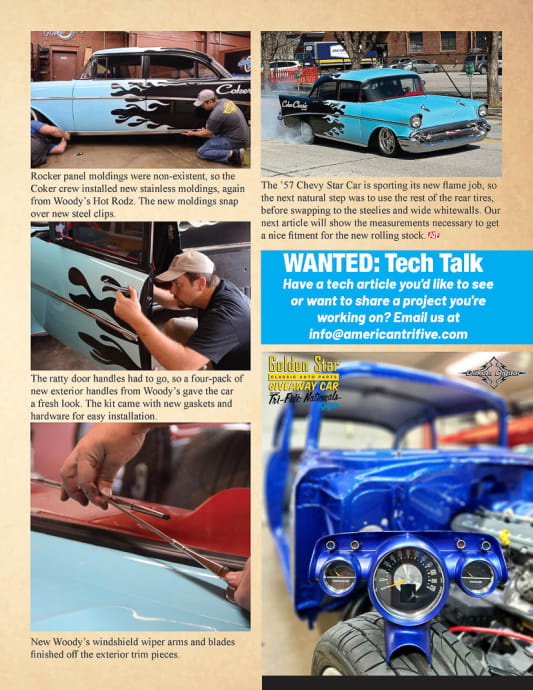
Rocker panel moldings were non-existent, so the Coker crew installed new stainless moldings, again from Woody’s Hot Rodz. The new moldings snap over new steel clips.
The ratty door handles had to go, so a four-pack of new exterior handles from Woody’s gave the car a fresh look. The kit came with new gaskets and hardware for easy installation.
New Woody’s windshield wiper arms and blades finished off the exterior trim pieces.
The ’57 Chevy Star Car is sporting its new flame job, so the next natural step was to use the rest of the rear tires, before swapping to the steelies and wide whitewalls. Our next article will show the measurements necessary to get a nice fitment for the new rolling stock.