Printed in The American Tri-Five magazine in Volume 9 : Issue 9
A Historical Overview
With origins as far back as 1913, the name Offenhauser has been etched into the halls of automotive history. With roots deep in the racing and hot rod communities, the name Offenhauser emerged from the innovative spirit of Fred H. Offenhauser. Along with Harry Miller, both gentlemen developed the legendary Offenhauser racing engine, affectionately known as the "Offy." Initially marketed as a marine engine, the Offenhauser engine quickly made its way to the racetracks, setting records and winning hearts along the way.
The Rise of the Offenhauser Engine
The Offy engine was an overhead cam monoblock 4-stroke internal combustion engine that showcased groundbreaking engineering. In 1930, a four-cylinder 151 cubic inch (2.47 L) Miller engine set a new international land speed record of 144.895 mph. This engine was refined into a more powerful twin overhead cam, four-cylinder variant and it became the backbone of American open-wheel racing.
The Offenhauser engine was a marvel of engineering, capable of producing up to 420 hp at 6,600 rpm with a compression ratio of 15:1. Its monoblock construction minimized mechanical failures, making it both powerful and reliable. From 1934 through the 1970s, the Offy dominated the Indianapolis 500, achieving podium finishes and pole positions with astonishing regularity.
Following the Miller Company’s bankruptcy in 1933, Offenhauser seized the opportunity to acquire rights to engines, tooling, and designs. Along with former Miller employees, Fred H. Offenhauser ushered in a new era of performance engineering. At this time, nephew Fred C. Offfenhauser went to work for his uncle Fred H. Offenhauser as a tool maker and master machinist as he was being groomed to take over the company. However, plans changed with the outbreak of WWII. By 1946, the Offenhauser name and its designs were sold to Louis Meyer and Dale Drake, who would propel the engine to unparalleled success, including 27 Indianapolis 500 wins.
The engine's impact on racing cannot be overstated. It wasn't just about winning; it was about pushing the boundaries of performance. The Offenhauser engine became synonymous with speed, innovation, and a relentless pursuit of excellence. Its legacy is a testament to the craftsmanship and dedication of the Offenhauser family and their team.
The Transition to Aftermarket Performance Parts
After the sale of the racing engine company to Meyers & Drake in 1946, Fred C. Offenhauser founded Offenhauser Equipment to fill the need for consumer speed equipment. The new company became a leader in the aftermarket performance parts sector, focusing on providing high-quality components for car enthusiasts and racers alike. This decision not only preserved the Offenhauser legacy but also embraced the burgeoning hot rod culture of the post war 1940s and beyond.
Ollie Morris, a pivotal figure in the company's history, contributed significantly to this transition. An accomplished driver and engineer, Morris's inventions, including the Dual Port intake, became cornerstones of Offenhauser’s aftermarket offerings. His designs revolutionized performance parts, setting standards that still resonate in the industry today.
A Family-Owned Legacy
Throughout its history, Offenhauser has remained family-owned, preserving the vision and values instilled by its founders. Fred C. Offenhauser and his brother Carl Offenhauser ran and grew the company from 1946 until 1978 when the company was bequeathed to Fred's sons, Jim and Tay, who then passed it to Tay’s son, Chris Offenhauser. This lineage of family leadership has ensured that the company maintains its commitment to quality, innovation, and customer satisfaction.
In 2015, Jason Curtis met Tay Offenhauser, and an opportunity arose for Tay to retire while passing the torch to Curtis as the new CEO. This transition marked a new chapter for Offenhauser, blending tradition with modern management strategies.
A Legacy of Engineering and Development
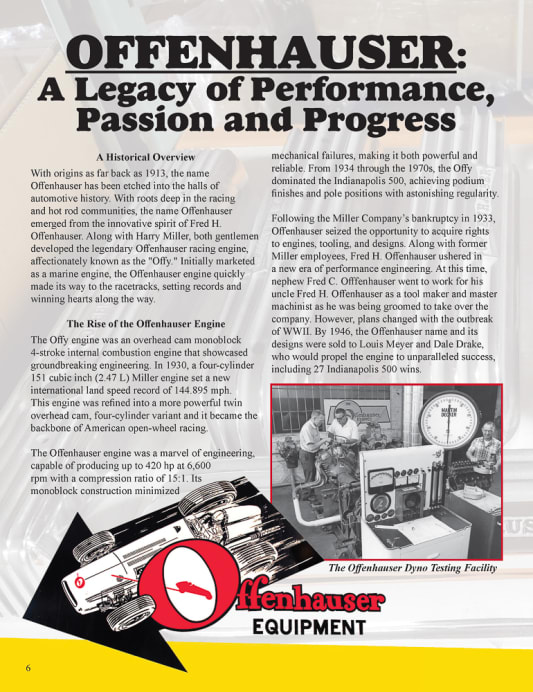
During the 1950s General Motors sent three of their brand new 265 CID small block Chevrolet engines to Offenhauser Equipment to be used in development of aftermarket parts. One of these engines was used in Ollie Morris’s famous “Smokin White Owl” drag car. The first successful rear wheel drag car to compete at NHRA. Using these sample 265 cu in blocks Offenhauser developed a series of intake manifolds such as: Single Quad, Dual Quad, Tri-power, 4-2, 6-2, Multi-Top Low Profile Cross Ram, and High Rise Tunnel Ram. Not only did they produce intake manifolds but they also developed valve covers, two piece timing chain covers, and multiple transmission adapters. Following the trend with other manufacturers, by the mid 60’s Offenhauser had developed upgraded intakes for every engine being sold in the US from all major manufacturers. By the mid to late 70’s Offenhauser had developed an entire line of 4 cylinder fuel efficient intakes for all major American and Japanese import engines. During this time all new parts were tested in Offenhauser’s very own state of the art engine dyno facility.
Offenhauser Today
As Offenhauser celebrates its long-standing legacy of continuous operation since 1946, the company is poised for a bright future. With plans to modernize its product offerings, Offenhauser is actively designing a full line of LS engine products and Vintage Port Injection (VPI) intake manifolds. This modernization effort aims to bridge the gap between classic performance and contemporary needs, ensuring that Offenhauser remains relevant in an ever-evolving automotive landscape.
In addition to modern products, Offenhauser is reviving old and out-of-production designs for engines like the Small Block Chevy, Ford Y-Block, Small Block Ford, Cadillac, Oldsmobile, Pontiac, Ford Flathead V8 60, and Ford FE. This commitment to revamping classic designs demonstrates the company’s dedication to honoring its roots while innovating for the future.
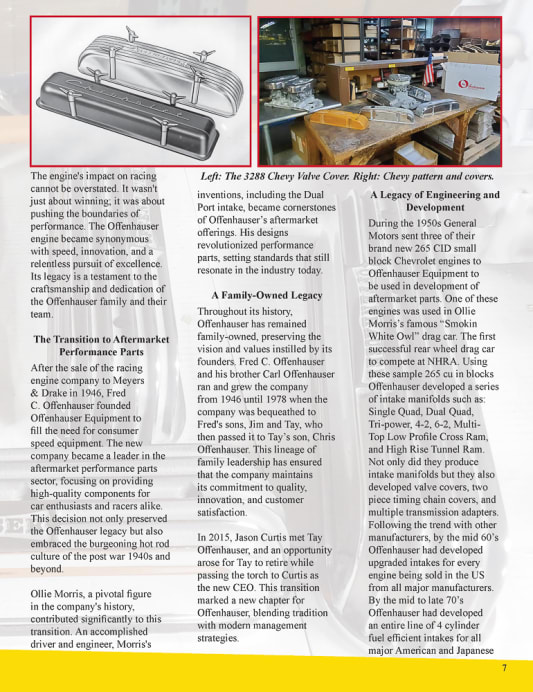
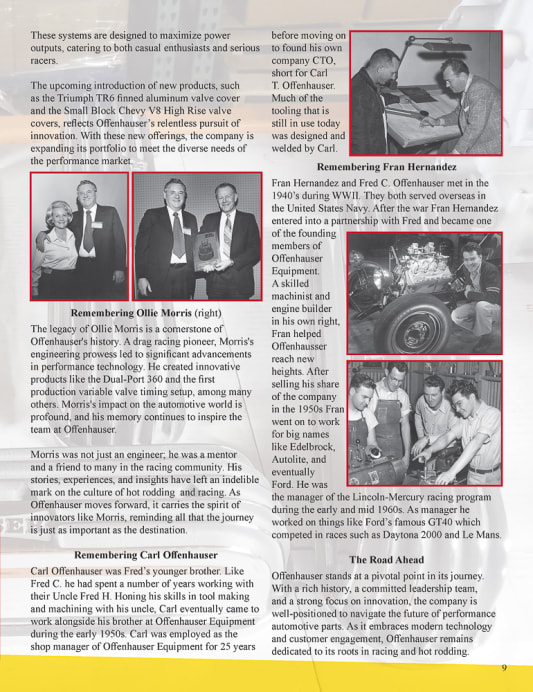
One of Offenhauser's exciting initiatives is its direct-to-consumer sales model through OffyDirect.com. This new approach allows customers to connect with the brand in ways that were previously unavailable. By engaging with customers directly, Offenhauser can gather valuable feedback and insights that drive product development. For instance, the newly launched Small Block Chevy valve cover was born from customer feedback regarding the need for PCV grommets, improved height for roller rockers, and a weld in baffle.
Increased participation in events like the Grand National Roadster Show 2025 also highlights Offenhauser's commitment to the automotive community. By being present at these events, the company strengthens its connection with enthusiasts and builders, further solidifying its place in the hearts of performance aficionados.
Offenhauser is actively collaborating with builders and other companies to create cutting-edge performance parts. A noteworthy partnership is with Fi-Tech, developing a range of VPI intake systems for various engines, including the Ford, Chevrolet, and Chrystler. These systems are designed to maximize power outputs, catering to both casual enthusiasts and serious racers.
The upcoming introduction of new products, such as the Triumph TR6 finned aluminum valve cover and the Small Block Chevy V8 High Rise valve covers, reflects Offenhauser’s relentless pursuit of innovation. With these new offerings, the company is expanding its portfolio to meet the diverse needs of the performance market.
Remembering Ollie Morris
The legacy of Ollie Morris is a cornerstone of Offenhauser's history. A drag racing pioneer, Morris's engineering prowess led to significant advancements in performance technology. He created innovative products like the Dual-Port 360 and the first production variable valve timing setup, among many others. Morris's impact on the automotive world is profound, and his memory continues to inspire the team at Offenhauser.
Morris was not just an engineer; he was a mentor and a friend to many in the racing community. His stories, experiences, and insights have left an indelible mark on the culture of hot rodding and racing. As Offenhauser moves forward, it carries the spirit of innovators like Morris, reminding all that the journey is just as important as the destination.
Remembering Carl Offenhauser
Carl Offenhauser was Fred’s younger brother. Like Fred C. he had spent a number of years working with their Uncle Fred H. Honing his skills in tool making and machining with his uncle, Carl eventually came to work alongside his brother at Offenhauser Equipment during the early 1950s. Carl was employed as the shop manager of Offenhauser Equipment for 25 years before moving on to found his own company CTO, short for Carl T. Offenhauser. Much of the tooling that is still in use today was designed and welded by Carl.
Remembering Fran Hernandez
Fran Hernandez and Fred C. Offenhauser met in the 1940’s during WWII. They both served overseas in the United States Navy. After the war Fran Hernandez entered into a partnership with Fred and became one of the founding members of Offenhauser Equipment. A skilled machinist and engine builder in his own right, Fran helped Offenhausser reach new heights. After selling his share of the company in the 1950s Fran went on to work for big names like Edelbrock, Autolite, and eventually Ford. He was the manager of the Lincoln-Mercury racing program during the early and mid 1960s. As manager he worked on things like Ford’s famous GT40 which competed in races such as Daytona 2000 and Le Mans.
The Road Ahead
Offenhauser stands at a pivotal point in its journey. With a rich history, a committed leadership team, and a strong focus on innovation, the company is well-positioned to navigate the future of performance automotive parts. As it embraces modern technology and customer engagement, Offenhauser remains dedicated to its roots in racing and hot rodding.
In the coming years, the Offenhauser name will continue to represent quality, performance, and innovation in the automotive industry. Whether through new product launches, collaborations, or direct customer interactions, the spirit of Offenhauser will live on, ensuring that the legacy of speed and excellence endures.
As we celebrate the history and accomplishments of Offenhauser, it is essential to recognize the passion that drives the company forward. From its humble beginnings in 1946 to its position as a leader in aftermarket performance parts, Offenhauser embodies the relentless pursuit of speed, power, and innovation.
For enthusiasts and racers alike, Offenhauser represents a commitment to quality and performance that transcends generations. As the company moves into the future, it does so with a nod to its past and a focus on the exciting possibilities that lie ahead. In a world where performance is king, Offenhauser remains a steadfast champion, ready to meet the needs of a new generation of automotive enthusiasts.
Parts for 1937-2009 Chevrolet
V8 - 283-327-350-400
5693 - Chevy Single Quad Equa-flow High Rise Manifold