Printed in The American Tri-Five magazine in Volume 10 : Issue 5
Written by Jake Ankney - Part of a Series
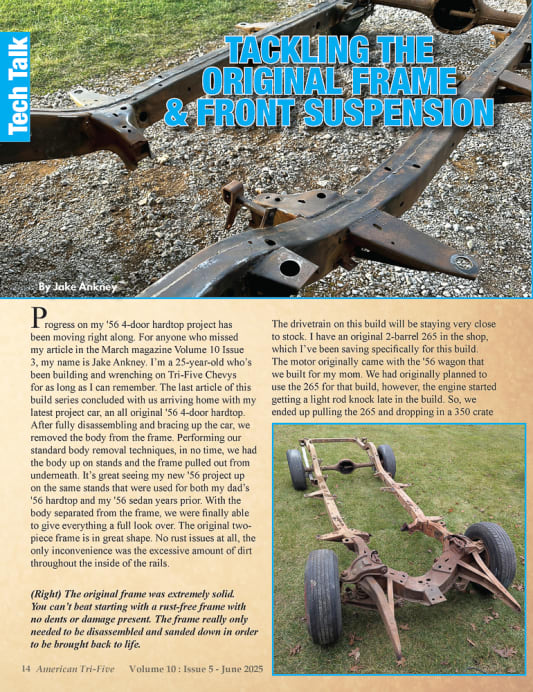
Progress on my '56 4-door hardtop project has been moving right along. For anyone who missed my article in the March magazine Volume 10 Issue 3, my name is Jake Ankney. I’m a 25-year-old who’s been building and wrenching on Tri-Five Chevys for as long as I can remember. The last article of this build series concluded with us arriving home with my latest project car, an all original '56 4-door hardtop. After fully disassembling and bracing up the car, we removed the body from the frame. Performing our standard body removal techniques, in no time, we had the body up on stands and the frame pulled out from underneath. It’s great seeing my new '56 project up on the same stands that were used for both my dad’s '56 hardtop and my '56 sedan years prior. With the body separated from the frame, we were finally able to give everything a full look over. The original two-piece frame is in great shape. No rust issues at all, the only inconvenience was the excessive amount of dirt throughout the inside of the rails.
The drivetrain on this build will be staying very close to stock. I have an original 2-barrel 265 in the shop, which I’ve been saving specifically for this build. The motor originally came with the '56 wagon that we built for my mom. We had originally planned to use the 265 for that build, however, the engine started getting a light rod knock late in the build. So, we ended up pulling the 265 and dropping in a 350 crate engine to finish out the build. Along with the 265 motor itself, I’ve also been collecting everything I need to convert the engine over to a 4-barrel power pack including the '56 only power pack heads, 265 4-barrel intake, and the corresponding 4-barrel air cleaner. As long as everything works out, this project will be equipped with a freshly rebuilt 265 power pack. The 4-door hardtop was an original 265 powerglide car, so the frame is already set up with all of the mounts and brackets I need.
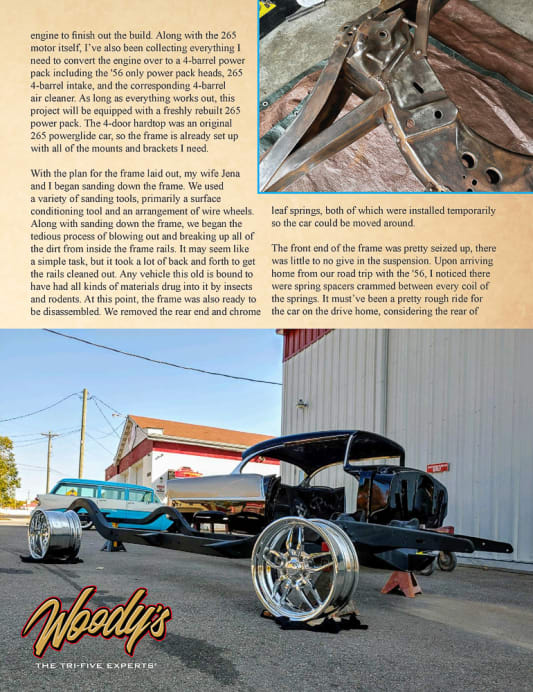
With the plan for the frame laid out, my wife Jena and I began sanding down the frame. We used a variety of sanding tools, primarily a surface conditioning tool and an arrangement of wire wheels. Along with sanding down the frame, we began the tedious process of blowing out and breaking up all of the dirt from inside the frame rails. It may seem like a simple task, but it took a lot of back and forth to get the rails cleaned out. Any vehicle this old is bound to have had all kinds of materials drug into it by insects and rodents. At this point, the frame was also ready to be disassembled. We removed the rear end and chrome leaf springs, both of which were installed temporarily so the car could be moved around.
The front end of the frame was pretty seized up, there was little to no give in the suspension. Upon arriving home from our road trip with the '56, I noticed there were spring spacers crammed between every coil of the springs. It must’ve been a pretty rough ride for the car on the drive home, considering the rear of the car was sitting on blocks, and the front suspension was locked up. Grandpa Jim, Dad, and I all tackled removing the front suspension. After getting the old shocks finally removed, we brought out the spring compressor. The original springs must be made from a large diameter steel because I don’t think I’ve ever struggled so much to get the top piece of the spring compressor in and oriented properly. After a lot of careful disassembly, we had the original springs, control arms, and spindles off.
With the frame disassembled, the sanding continued until every surface was cleaned up and smooth. Jena and I applied “Eastwood Rust Encapsulator Plus” to the bare frame. The color is titled matte black, however, the end finish turned out much closer to a satin. Thankfully, a satin finish was what I wanted anyway, so that really worked out for the better. After a few coats of paint, the frame was nicely sealed up and looking fresh again. We were quickly approaching our next roadblock, which was the lack of an actual rear end. I do have a '56 parts car in storage, which I had considered robbing the stock rear end and leaf springs out of. However, there just wasn’t enough space to do so safely in its current location.
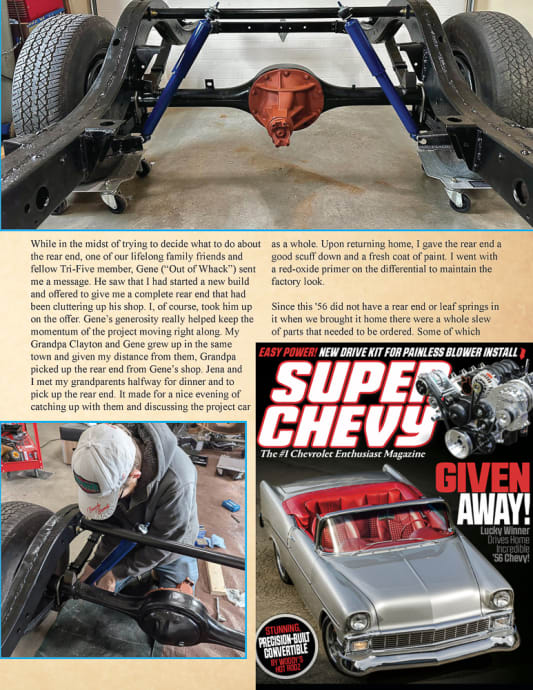
While in the midst of trying to decide what to do about the rear end, one of our lifelong family friends and fellow Tri-Five member, Gene (“Out of Whack”) sent me a message. He saw that I had started a new build and offered to give me a complete rear end that had been cluttering up his shop. I, of course, took him up on the offer. Gene’s generosity really helped keep the momentum of the project moving right along. My Grandpa Clayton and Gene grew up in the same town and given my distance from them, Grandpa picked up the rear end from Gene’s shop. Jena and I met my grandparents halfway for dinner and to pick up the rear end. It made for a nice evening of catching up with them and discussing the project car as a whole. Upon returning home, I gave the rear end a good scuff down and a fresh coat of paint. I went with a red-oxide primer on the differential to maintain the factory look.
Since this '56 did not have a rear end or leaf springs in it when we brought it home there were a whole slew of parts that needed to be ordered. Some of which included replacement leaf springs, tie pads, shackles, and of course, new shocks. Once the rear end parts arrived, it was time for yet another Saturday with the family out in the shop. The reproduction parts all worked out quite well. For now, I’m going with stock heights in the rear. However, if I change my mind once I see the frame with the body attached, I can always add in lowering blocks.
While in the process of rebuilding the frame, I figured now’s the time to install a shock bar from Shafer’s Classic. I definitely feel more comfortable keeping the stress of the shocks off the rear of the floor. In no time at all, we had a proper rear end installed on the frame. It’s always enjoyable watching these builds progress at a fairly constant speed.
Over the Christmas season, I received a handful of parts for the '56 project. That’s always one great thing about being surrounded by a family who share the same hobbies. I can recall years past of receiving parts back from chrome plating, parts necessary to continue moving forward, and other odds and ends that would be needed down the line. This year was no different, I primarily received parts to complete the frame rebuild. Some of which included new coil springs, tie rods, front shocks, ball joints, steering arms, and body mount bushings. I’m very blessed to receive these automotive gifts from my family around the holidays.
In the lead up to the front suspension install, Jena and I spent some time in the shop pressing out the old bushings and rebuilding the upper and lower control arms. I hadn’t dealt with control arms that were seized up like this before, so we had to learn a bit as we went.
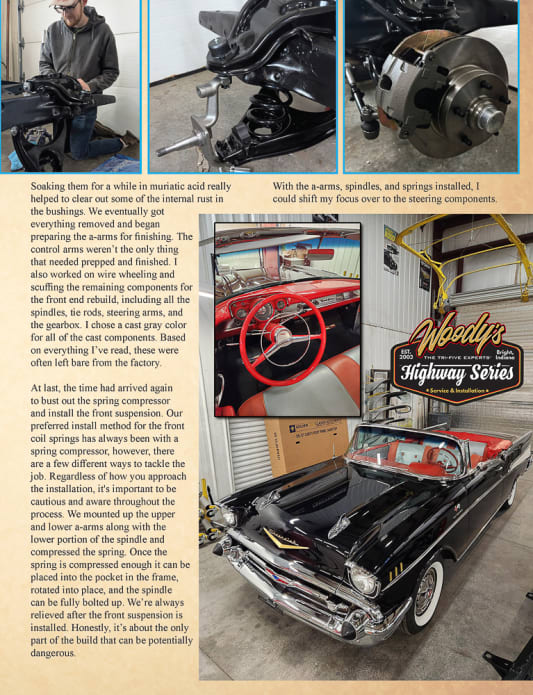
Soaking them for a while in muriatic acid really helped to clear out some of the internal rust in the bushings. We eventually got everything removed and began preparing the a-arms for finishing. The control arms weren’t the only thing that needed prepped and finished. I also worked on wire wheeling and scuffing the remaining components for the front end rebuild, including all the spindles, tie rods, steering arms, and the gearbox. I chose a cast gray color for all of the cast components. Based on everything I’ve read, these were often left bare from the factory.
At last, the time had arrived again to bust out the spring compressor and install the front suspension. Our preferred install method for the front coil springs has always been with a spring compressor, however, there are a few different ways to tackle the job. Regardless of how you approach the installation, it's important to be cautious and aware throughout the process. We mounted up the upper and lower a-arms along with the lower portion of the spindle and compressed the spring. Once the spring is compressed enough it can be placed into the pocket in the frame, rotated into place, and the spindle can be fully bolted up. We’re always relieved after the front suspension is installed. Honestly, it’s about the only part of the build that can be potentially dangerous.
With the a-arms, spindles, and springs installed, I could shift my focus over to the steering components. After consulting the assembly instructions, I had the steering linkage all mocked up on the workbench. All that was left to do was to carry it over to the frame and bolt it up. The cast gray color really helps to make the steering components stand out. This may be my new go to over the standard black everything is typically painted. I also temporarily installed the gearbox, primarily to keep the components from rubbing, but also to see how everything looked. I performed a very temporary alignment and got everything straight enough for the time being.
The car will, of course, be getting a full professional alignment once it’s much further along.
The last bit of progress on the frame has been the installation of the disc brakes. As mentioned before, I’m going for a near stock chassis, however, safety is important to me. With that said, the '56 will also be getting a dual reservoir master cylinder. The disc brake kit I chose to install is identical to the kit that’s on my '56 sedan. It does add a slight offset to the front wheels, but the appearance is negligible. You really can’t beat the cost of modern-day kits along with the ease of installation and use. Anyone who has ever laid under a car with drum brakes all around it knows the struggle to manually adjust all four corners to prevent the car from pulling. Front discs to me are a no brainer.
The restoration of the frame is really starting to take shape. There are still a few odds and ends left to finish up, like routing the brake and gas lines. However, those projects will be tackled once the project, as a whole, gets further along. As of now, I’ll be shifting my attention over to the body. There is a whole host of structural and fabrication work that will go on before the body can be reunited with this freshly completed frame. As far as the next steps are concerned, I decided pretty early on that installing a full floor pan in the car is going to be the way to go. In the next article, we’ll walk through my progress on removing the old floor and installing the new one…