Printed in The American Tri-Five magazine in Volume 10 : Issue 5
Written by Jake Ankney - Part of a Series
In this article we’ll be going through my progress of bracing up my '56 4-door hardtop, removing the original floor, and installing a complete floor pan. Upon dissembling the '56 Sports Sedan, we had the joy of tearing out the old carpet which had been left in the car as it sat outside for years. Given the fact the carpet was still in and drawing moisture, the floor pan was thinned out pretty good. We evaluated the condition of the braces and the floor pan and debated which direction we should go. I had initially thought that maybe we could perform a handful of small patches, but ultimately, we were better off biting the bullet and replacing the full floor.
This was a bittersweet decision, but clearly the right choice. At the end of the day this is a 4-door hardtop, the strength of the floor/braces is integral to the structure of the car. The thought of removing the floor out of any vehicle can be a bit frightening. However, this was a challenge that I was more than willing to pursue.
While we were disassembling the '56, I began adding braces to the inside. The door gaps were all really nice upon bringing the car home, so I felt confident securing the b-pillars in their current position. I left the doors on and latched while installing the inner structure, using a Unistrut channel for the majority of the bracing. Unistrut is fairly inexpensive at ten-foot lengths and readily available locally. I recalled Jason, a fellow Tri-Five Community member, who had installed a full floor pan in Eldin’s ‘57 Sports Sedan and based the position of the inner structure after Jason’s layout. I welded 6 large Unistrut braces, the first was welded under the dash and spanned between the cowl vents and the door jambs. Next, I welded a brace across the inside of the b-pillars, this will help prevent them from folding inward. Then, I placed a long span from the top of the front beam to the rear of the car. I repeated this on both sides and welded it to the existing structure as well as the rear interior wall of the '56. Next, I welded in a brace at the rear of the inner structure near the package tray. Finally, I added a diagonal brace and a few lengths of square tube connecting the bottom of the b-pillars to the inner structure.
After all of the bracing had been installed, we removed the doors from the '56. I made sure to document as many measurements as possible while the car was still sitting on its original frame. Although the structure of the bracing was very sturdy, it doesn’t hurt to have backup measurements in case something isn’t working out when installing the new floor. Plus, it’s good to have something to cross reference to reassure that everything is positioned back to where it used to be. Both Grandpa’s, Jim and Clayton, were over working on the '56 the day we finished the inner bracing and started removing the doors. Up to this point, I had been spraying the body mount bolts daily hoping this would help them loosen up. The original braces put up a good fight though, in the end the majority of the body mount bolts snapped off inside the braces and a few bolts had to be cut off. I think this alone justifies the new floor pan; I would not want to drill out all of the broken bolts from the few salvageable braces. By the end of the weekend, we had the '56 fully braced up, disassembled, and ready for the body to be removed from the frame.
In the lead up to the following weekend, Grandpa Jim ended up in the emergency room. He had caught a flu which had completely taken over his immune system. He’s been fighting liver and colon cancer for the past three years. He’s beaten it a few times, but the cancer always seems to persist. Given his regular chemo treatments, his immune system is very vulnerable. Thankfully, he was able to push through, if there’s one word to describe my Grandpa Jim it’d be “determined”. He’s the most determined guy I know; he always bounces back from whatever life throws at him. It was bittersweet seeing him struggle to get words out when visiting him in the hospital. It was as if the flu had taken over his ability to think and speak clearly. He perked right up when he saw my wife Jena and I arrived to visit though. Between his broken and spaced-out words, he was asking all about the '56 project and letting me know that he hoped to continue helping when he was able to again. Grandpa Jim has and continues to be my biggest supporter, he’s been beside me in the shop every step of the way throughout all of our builds. I’m very grateful that after the flu passed, he regained his cognitive abilities.
With Grandpa Jim recovering, dad and I pressed forward and tackled the body removal. We used our traditional methods to remove the body from the frame. Those methods include placing eye bolts in the front body mount locations and using come-alongs to lift the front of the body up off the frame. Once the body was elevated, we removed the front tires and spanned a 4x4 across sawhorses for the front of the body to sit on. We took a similar approach with the rear and after enough back and forth we were able to slide the frame out from under the body. It was nice having a solid built 2x6 constructed building to assist with heavy tasks like this.
My previous article picked up from this point and followed the frame build once the body had been removed. Throughout that time, I had been slowly chipping away at making progress on removing the old floor from the hardtop. Jena and I spent some time out in the shop removing the bulk of the original floor. A fair amount of the sheet metal crumbled upon touching it, but there were a few spots that were still pretty solid. Since we were primarily focused on the frame build, we tackled removing the floor in waves. The first wave was removing some of the braces and the larger floor pan sections. I kept the center brace, rear seat brace, and the top of the drive tunnel intact until we were a bit closer to the floor install. I’m unsure if this approach was entirely necessary, but I didn’t want to encourage any part of the body to shift while we were focused on the frame build.
When it came time to go pick up the new floor, Dad and I decided to build a palette that could be strapped to the top of my Silverado truck bed. This palette worked out really well. If you plan to transport a floor yourself and don’t want to use a trailer, I highly recommend it. I was able to easily screw down 2x4’s on top to raise the floor up above the inner rockers and screw down lag bolts through a handful of the body mount locations. Now that we had the new floor, I had considered painting the underside prior to installing it into the '56. However, we’re still too early into the build for that to be viable. If the metal fabrication was completed, then it probably would’ve been a good idea, but all of that work is still yet to come.
With the floor in hand, I began the final wave in removing what was left of the original floor. I used an air hammer for the majority of this work. My goal was to try and split the seam of the rocker and the floor/inner rockers. I have a new set of rockers to install on the car eventually, but I needed the original rockers to stay in place so the b-pillars wouldn’t move from their current position. It took about three evenings to get all of the rocker seams split. The driver's side was a breeze; however, the passenger side was a lot more solid. After the rockers were cleaned up, I removed everything around the rear seat area and the transmission tunnel hump. Lastly, I had to separate the center brace from the 4-door hardtop b-pillars. This went very similar to the inner rockers. The driver’s side was more than willing to peel off and the passenger’s side put up a good fight. By this point, the original floor had been completely removed, and I could easily access and clean up all of the otherwise unreachable areas, like up inside the b-pillars. I made sure to sand, prep, and paint any unreachable areas with rust inhibitor. At the same time, I also prepped all of the areas that would be mating with the new floor pan with zinc-weld through primer.
There was one last thing to do before I could install the full floor pan. The toe-kicks on the hardtop were in a pretty similar condition to the rest of the floor, very rotten especially towards the bottom. I drilled out the original spot welds that held the toe-kicks onto the front body mount brace and cut out the section I needed to replace. I then could simply place the cutout section on a nice toe-kick which had been pulled from a '56 parts car. I traced around the old piece, cut it out, held it up to the car, tack welded it in, and plug welded the flange to the brace. With the critical areas of the toe-kick replacement completed, we sat the new floor pan onto the frame from my '56 parts car. This was the same frame that I had considered robbing the rear end components out of in the last article. Thankfully I didn’t and this frame can now be used as a temporary roller for the hardtop. As much as I’d love to see the '56 sitting on the freshly finished frame, we're once again still quite a ways away from having all of the body fabrication completed. I’d rather not destroy the nice new frame and instead I’d prefer to have it ready to go when the time comes.
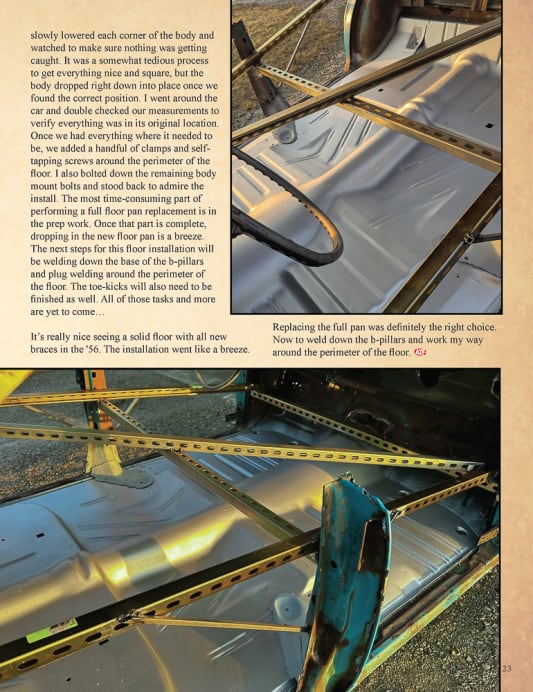
Grandpa Jim came over to help as we rolled the frame under the '56 hardtop. The frame had the body mount bushings on, and the full new floor bolted down. We slowly lowered each corner of the body and watched to make sure nothing was getting caught. It was a somewhat tedious process to get everything nice and square, but the body dropped right down into place once we found the correct position. I went around the car and double checked our measurements to verify everything was in its original location. Once we had everything where it needed to be, we added a handful of clamps and self-tapping screws around the perimeter of the floor. I also bolted down the remaining body mount bolts and stood back to admire the install. The most time-consuming part of performing a full floor pan replacement is in the prep work. Once that part is complete, dropping in the new floor pan is a breeze. The next steps for this floor installation will be welding down the base of the b-pillars and plug welding around the perimeter of the floor. The toe-kicks will also need to be finished as well. All of those tasks and more are yet to come…
It’s really nice seeing a solid floor with all new braces in the '56. The installation went like a breeze. Replacing the full pan was definitely the right choice. Now to weld down the b-pillars and work my way around the perimeter of the floor.