855.567.1957
Phone Hours are Monday - Friday
10 am - 4 pm EST
Producers of the American Tri-Five Association
& the Tri-Five Nationals presented by CPP

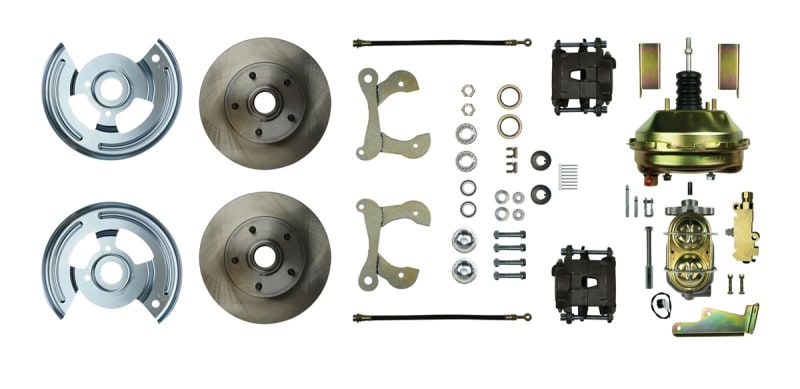
But for those who ACTUALLY drive these cars, there’s not a doubt in the world that disc brakes are a worthwhile improvement. By nature, disc brakes offer more heat dissipation, which means less fade, which means shorter stopping distance, ultimately meaning a safer car overall. There is simply no debating this one. At the minimum, the front brakes should be swapped out for discs. But as always, if budget allows, a 4-wheel disc setup will always be the better performing option of the bunch (P/N RSF-FSC554).
On top of braking ability and performance, even your base model disc brake kit will come with a dual master cylinder, opposed to the factory single. For anyone who’s experienced a brake line failure with a single master knows, it’s a harrowing experience you only want to do *once*, as in the event of a pressure leak with a single master, ALL the brakes fail completely. A dual master separates the front system from the rear, and won’t completely kill stopping power in the event of a leak/break/failure. So, bonus there as well.
If your pocketbook allows a mild upcharge, you can upgrade to power brakes all the same, requiring less effort for the same braking power as a manual setup. The 8” dual-diaphragm boosters are my weapon of choice for vacuum-assisted power brakes.
The Right Stuff brake kits have been my go-to for some time, as an affordable, readily available option for upgrading any Tri-Five to disc brakes.
1955-57 Chevrolet Bel Air/Nomad, Manual Front Disc Brake Conversion features:
Specifications:
Additional Oversize fees apply, amount will display in cart. This item does not qualify for FREE shipping.
Trust the Tri-Five Experts for all your 1955, 1956 & 1957 Chevy Parts.
NOTE: Stock may vary. Please call for current inventory.
Woody's sells the best products available on the market for your Tri-Five. Part numbers listed online and in our catalog are for reference purposes only unless the manufacturer is explicitly stated.

Thank you for choosing Woody's for all your 1955, 1956, and 1957 Chevy needs! Not only do we sell parts, build all new bodies, assemble chassis, and install upgrades, we also publish nine full-color issues of a Tri-Five Only magazine full of 1955-57 Chevys, tech articles, and more. Plus, we produce the world's largest gathering of Tri-Fives the second full weekend of August in Bowling Green, Kentucky. Become a part of the American Tri-Five Association with nearly 10,000 members or register for the Tri-Five Nationals presented by CPP and join other Tri-Five fans as we celebrate the greatest cars ever made: the 1955 1956 1957 Chevrolets!


